
AI in Healthcare: 15 Powerful Ways Artificial Intelligence Is Transforming Healthcare
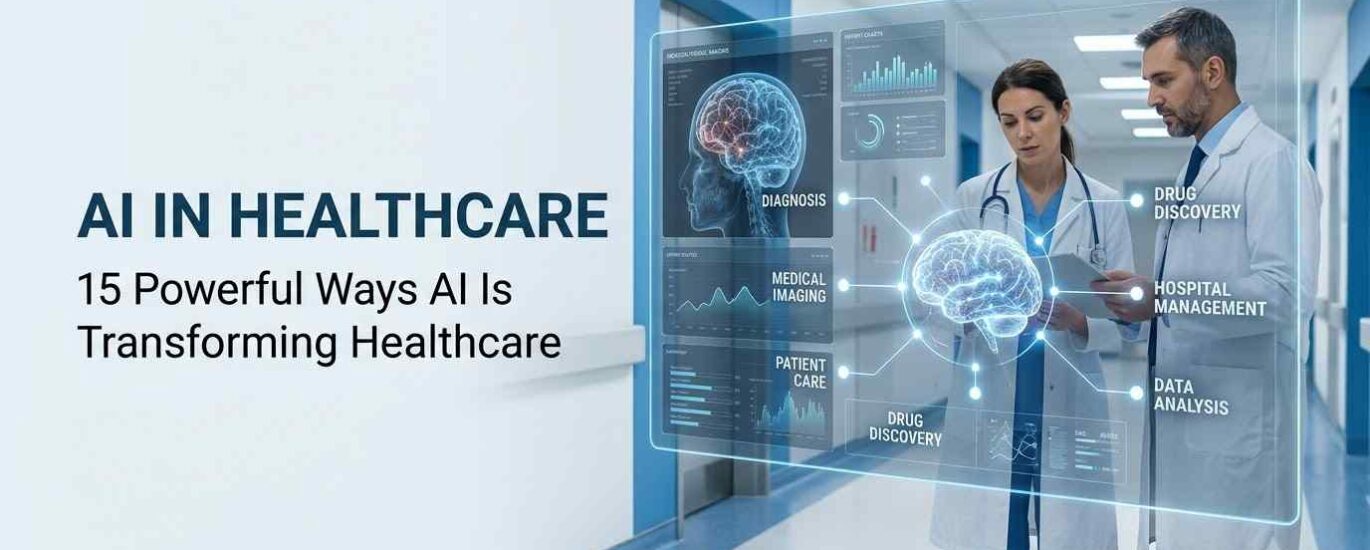
AI in Healthcare is changing how healthcare organizations collect information, support clinicians, manage operations, communicate with patients and conduct medical research. Artificial intelligence can analyze large amounts of data, identify patterns and assist with tasks that would otherwise require significant human time.
However, AI is not a replacement for doctors, nurses or other healthcare professionals. Its value comes from helping people make better-informed decisions, automate repetitive work and improve healthcare workflows.
The World Health Organization (WHO) recognizes significant potential for AI in diagnosis, clinical care, drug development, disease surveillance and health-system management, while also emphasizing the need for safety, ethics, governance and equity.
In this guide, we will explore 15 practical ways AI in Healthcare is being used, its benefits, limitations and what healthcare organizations should consider before adopting AI.
Table of Contents
- What Is AI in Healthcare?
- How Does AI in Healthcare Work?
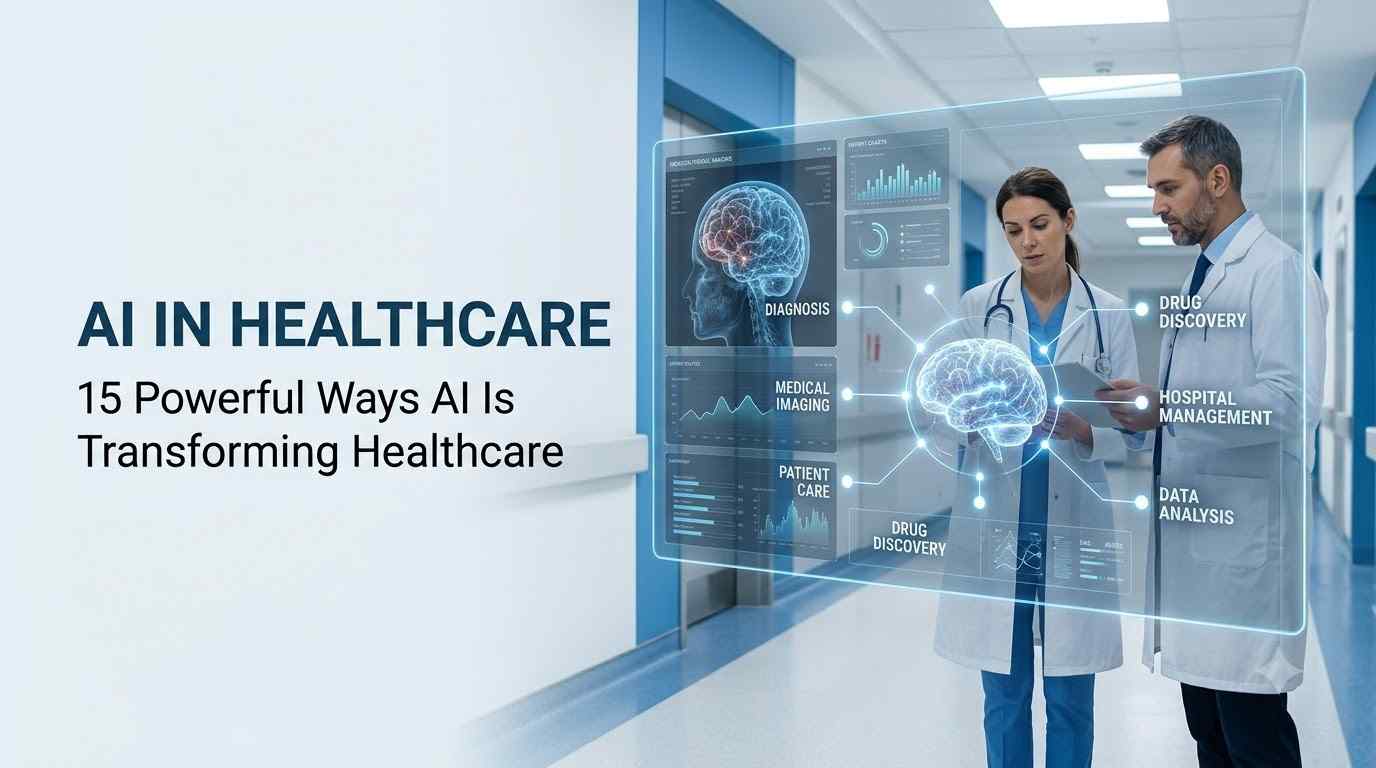
- 15 Uses of AI in Healthcare
- Benefits of Artificial Intelligence in Healthcare
- AI Medical Diagnosis
- AI in Medicine and Drug Discovery
- AI for Healthcare Administration
- Risks and Challenges of Medical AI
- How Healthcare Organizations Can Start Using AI
- Future of AI in Healthcare
- Frequently Asked Questions
What Is AI in Healthcare?
AI in Healthcare refers to the use of artificial intelligence technologies to perform or support tasks related to healthcare delivery, medical research, administration, public health and patient services.
Depending on the application, AI systems may work with:
- Medical images
- Electronic health records
- Clinical data
- Laboratory results
- Patient-generated information
- Medical literature
- Administrative data
- Operational and financial data
AI can identify patterns in data, generate summaries, classify information, support predictions and automate repetitive processes.
Modern generative AI systems can also work with multiple types of information and generate text, images or other outputs. WHO’s 2025 guidance specifically discusses large multi-modal models and their potential applications in healthcare, research, public health and drug development.
How Does AI in Healthcare Work?
A simplified AI healthcare workflow looks like this:
Healthcare Data → AI Model → Pattern Analysis → Output → Human Review → Action
For example, an AI system may analyze a medical image and identify an area that deserves closer attention. A qualified healthcare professional can then review the AI output alongside the patient’s medical history and other relevant information.
The important point is that AI output should not automatically become a medical decision.
The National Academy of Medicine notes that AI offers opportunities to improve healthcare outcomes and operational efficiency, but also highlights concerns involving safety, equity, regulation and implementation.
15 Powerful Uses of AI in Healthcare
1. AI Medical Diagnosis
One of the most discussed applications of AI in Healthcare is supporting medical diagnosis.
AI systems can analyze certain types of medical information and identify patterns that may be difficult or time-consuming to detect manually.
Medical imaging is one important area. AI-enabled systems can assist with the analysis of images such as X-rays, CT scans, MRI scans and other diagnostic images, depending on the specific technology and intended use.
However, AI diagnosis should not be interpreted as an automatic replacement for a qualified medical professional.
Research has also demonstrated why human oversight matters. NIH reported findings in which an AI model performed well on medical-image questions but still made errors in describing images and explaining its reasoning.
2. Medical Imaging Analysis
AI can be particularly useful for analyzing large numbers of medical images.
Potential applications include:
- Detecting patterns in radiology images
- Highlighting areas for review
- Supporting image classification
- Prioritizing certain cases
- Assisting workflow management
The FDA maintains a list of AI-enabled medical devices authorized for marketing in the United States. These devices have gone through applicable premarket requirements related to safety and effectiveness for their intended uses.
This is an important distinction: not every AI tool available online is a clinically validated medical device.
3. AI in Medicine and Clinical Decision Support
AI can support clinicians by organizing and analyzing large amounts of information.
For example, an AI system may help summarize:
- Patient history
- Clinical notes
- Relevant medical information
- Research literature
- Test results
- Treatment-related information
The purpose is to reduce information overload and help healthcare professionals work more efficiently.
Final clinical decisions should remain with appropriately qualified professionals who can consider the patient’s complete situation.
4. AI for Patient Support
Healthcare organizations can use AI-powered systems to handle certain routine patient interactions.
Examples include:
- Appointment information
- General administrative questions
- Reminders
- Navigation of healthcare services
- Frequently asked questions
- Basic communication support
AI chatbots can potentially provide support outside normal office hours, but they should have clear boundaries.
For symptoms, emergencies or clinical decisions, patients should be directed to appropriate healthcare professionals rather than relying solely on an AI chatbot.
5. AI for Healthcare Administration
Healthcare organizations handle a huge amount of administrative work.
AI can help automate or accelerate tasks such as:
- Document processing
- Data entry
- Appointment workflows
- Record summarization
- Administrative communication
- Report preparation
- Scheduling support
This can allow healthcare workers to spend more time on higher-value tasks.
Operational efficiency is one of the major areas identified in research on AI applications in health systems.
6. AI for Medical Documentation
Healthcare professionals spend significant time documenting patient encounters.
AI-assisted documentation tools can potentially help with:
- Transcription
- Clinical note drafting
- Meeting summaries
- Information organization
- Documentation workflows
However, AI-generated documentation must be reviewed for accuracy before it becomes part of an official medical record.
A small transcription error can become important when it affects medication, diagnosis or treatment information.
7. AI in Drug Discovery
Another important application of AI in Medicine is pharmaceutical research.
AI can help researchers analyze large datasets and identify patterns that may support:
- Drug discovery
- Molecule screening
- Target identification
- Research prioritization
- Clinical development workflows
WHO identifies drug development and pharmaceutical applications among the areas where AI has significant potential, while also emphasizing the need to manage risks.
AI does not eliminate the need for laboratory research, clinical trials or regulatory evaluation.
8. AI for Medical Research
Researchers have access to enormous amounts of scientific literature and healthcare data.
AI can help researchers:
- Search large collections of information
- Summarize research
- Identify relevant studies
- Analyze datasets
- Generate research hypotheses
- Organize scientific information
Generative AI may make some research workflows faster, but researchers still need to verify sources and results.
An AI-generated citation or research summary should never automatically be treated as accurate.
9. AI for Disease Surveillance
AI can also support public health activities.
Large datasets can be analyzed to identify patterns associated with:
- Disease trends
- Public health risks
- Outbreak signals
- Population health patterns
WHO lists disease surveillance and outbreak response among the areas where AI can play a role.
The effectiveness of such systems depends heavily on the quality, completeness and representativeness of the underlying data.
10. AI for Personalized Healthcare
Healthcare is increasingly moving toward more personalized approaches.
AI can help analyze multiple pieces of information and identify patterns that may support individualized care.
Potential applications include:
- Risk assessment
- Patient segmentation
- Treatment support
- Monitoring
- Personalized communication
However, personalized healthcare requires careful handling of patient data and should not be confused with an AI independently prescribing treatment.
11. AI for Remote Patient Monitoring
AI can analyze information generated through connected healthcare devices and monitoring systems.
Depending on the technology, this may help identify changes in health-related measurements that require attention.
Potential applications include:
- Chronic disease monitoring
- Remote care
- Patient alerts
- Health trend analysis
- Follow-up support
These systems must be designed around appropriate clinical workflows so that important alerts are not missed or overwhelmed by false alarms.
12. AI for Healthcare Marketing
AI is not limited to clinical applications.
Healthcare businesses can also use AI for marketing tasks such as:
- Content planning
- SEO research
- Social media ideas
- Email campaigns
- Advertisement copy
- Audience segmentation
- Website content
- FAQ generation
However, healthcare marketing requires greater caution than many other industries.
Claims about treatments, outcomes or medical benefits should be factually accurate and reviewed by appropriate experts before publication.
13. AI for Hospital Operations
Hospitals and large healthcare organizations manage complex operations.
AI can potentially assist with:
- Resource planning
- Scheduling
- Workflow optimization
- Demand forecasting
- Staff planning
- Inventory management
- Operational reporting
The goal is not simply to “use AI,” but to improve a measurable business or operational outcome.
For example:
Manual reporting → AI-assisted reporting → Human verification → Faster management decision
This is a more practical AI implementation than adopting a tool without a specific business problem.
14. AI for Healthcare Data Analysis
Healthcare organizations generate enormous amounts of data.
AI can help analyze information to identify:
- Trends
- Operational problems
- Resource utilization
- Patient-flow patterns
- Financial patterns
- Performance indicators
Healthcare leaders can potentially use these insights to make better operational decisions.
But data quality is critical. If the underlying data is incomplete or biased, AI results can also be unreliable.
15. AI for Healthcare Automation
The biggest opportunity may come from connecting AI with automation.
For example:
Patient inquiry → AI classification → Appropriate department → Staff notification → Follow-up
Or:
Appointment request → Scheduling system → Confirmation → Reminder → Follow-up
These workflows combine AI with traditional software automation.
The objective should always be measurable:
Less manual work + faster response + fewer errors + better service
Benefits of Artificial Intelligence in Healthcare
When implemented appropriately, AI can provide several potential benefits.
1. Faster Information Processing
AI can process and organize large datasets much faster than manual workflows.
2. Reduced Administrative Work
Automation can reduce repetitive documentation and administrative tasks.
3. Better Workflow Efficiency
Healthcare organizations can use AI to optimize certain operational processes.
4. Support for Healthcare Professionals
AI can act as an assistant for information organization, documentation and other defined tasks.
5. Research Acceleration
AI can help researchers analyze large datasets and scientific information.
6. Improved Patient Engagement
AI-powered communication systems can help with certain routine interactions and information delivery.
The National Academy of Medicine identifies opportunities for AI to improve clinical and team outcomes, reduce costs and support population health, while emphasizing the need for careful implementation.
AI Medical Diagnosis: Can AI Replace Doctors?
No.
AI can support diagnosis in specific applications, but replacing doctors entirely is not a realistic or safe assumption.
Healthcare decisions involve much more than pattern recognition. Doctors and other healthcare professionals consider:
- Patient history
- Symptoms
- Physical examination
- Test results
- Medical context
- Patient preferences
- Risk factors
- Clinical guidelines
- Possible alternative diagnoses
AI can provide useful assistance, but responsibility and clinical judgment remain critical.
WHO’s 2026 discussion on AI and evidence-informed health policy similarly emphasizes that AI should augment human judgment rather than remove it.
Risks and Challenges of Medical AI
The growth of Medical AI also creates important challenges.
Data Privacy
Healthcare data can contain extremely sensitive personal information. Organizations need strong controls around data access, storage and processing.
Bias
AI systems can produce biased results when their training or operational data does not adequately represent the populations being served.
Incorrect Outputs
AI systems can make mistakes, including generating plausible but incorrect information.
Lack of Transparency
Some AI systems can be difficult for users to understand or interpret.
Regulation
Healthcare AI may be subject to medical-device, privacy, professional and other regulatory requirements depending on its intended use and jurisdiction.
WHO has repeatedly emphasized safety, transparency, accountability, equity and human oversight in AI for health.
How Can a Healthcare Business Start Using AI?
Healthcare organizations should not begin with:
“Which AI tool should we buy?”
A better question is:
“Which problem are we trying to solve?”
Use this five-step approach:
Step 1: Identify a Repetitive Task
Find a process that consumes significant employee time.
Step 2: Define the Expected Result
For example:
- Reduce response time
- Reduce documentation time
- Improve scheduling
- Reduce manual reporting
Step 3: Test AI on a Small Scale
Start with a controlled pilot instead of deploying AI across the entire organization.
Step 4: Keep Human Oversight
Important healthcare decisions should have appropriate professional review.
Step 5: Measure the Results
Track:
- Time saved
- Cost
- Accuracy
- Error rate
- User satisfaction
- Patient experience
- Operational improvement
If the AI system does not produce measurable value, there may be no reason to continue using it.
What Is the Future of AI in Healthcare?
The future of AI in Healthcare will likely involve deeper integration between AI systems, healthcare software, medical devices, clinical workflows and data platforms.
Generative AI may increasingly support documentation, information retrieval, patient communication and research workflows, while specialized AI systems continue to be developed for specific medical applications.
At the same time, regulation, data governance, safety testing and human oversight will become increasingly important.
WHO’s 2025 assessment of AI readiness across the European Region found that AI adoption is already occurring across health systems, while legal uncertainty, funding, data governance and workforce readiness remain important challenges.
The future therefore is not simply about making AI more powerful. It is about making AI safe, useful, transparent and appropriately integrated into healthcare systems.
Frequently Asked Questions
What is AI in Healthcare?
AI in Healthcare means using artificial intelligence technologies to support healthcare delivery, medical research, administration, public health and patient services.
How is AI used in healthcare?
AI is used in areas such as medical imaging, diagnosis support, documentation, research, drug discovery, patient communication, disease surveillance, healthcare administration and operational analysis.
What is AI in Medicine?
AI in Medicine refers to the application of artificial intelligence to medical and clinical activities, including research, diagnosis support, medical information processing and certain healthcare workflows.
Can AI diagnose diseases?
Some AI-enabled systems can assist with specific diagnostic tasks, including certain medical-image analysis applications. However, AI output should not automatically be treated as a diagnosis, and qualified healthcare professionals remain important for clinical interpretation and decision-making.
What are the benefits of AI in healthcare?
Potential benefits include faster data analysis, reduced administrative workload, improved workflow efficiency, research support and assistance with certain healthcare tasks.
What are the risks of AI in healthcare?
Important risks include inaccurate outputs, privacy concerns, bias, lack of transparency, cybersecurity issues, inappropriate use and unclear accountability.
Is AI going to replace doctors?
AI is more realistically viewed as a tool that can assist healthcare professionals rather than a complete replacement for doctors. Healthcare requires clinical judgment, context, communication and accountability.
AI in Healthcare is moving from an experimental technology toward practical applications across healthcare delivery, medical research, administration, public health and business operations.
Its strongest value may not come from replacing healthcare professionals. Instead, AI can help professionals process information faster, reduce repetitive work, support research and improve selected workflows.
At the same time, healthcare is a high-stakes environment. Privacy, accuracy, bias, safety, regulation and human oversight cannot be treated as optional features.
The best strategy for a healthcare organization is therefore simple:
Identify a real problem → Test AI → Keep human oversight → Measure results → Scale only when it works.
AI can become a powerful healthcare technology, but its success ultimately depends on how responsibly and effectively people use it.