
AI in Medicine: 15 Powerful Ways Artificial Intelligence Is Transforming Modern Medicine
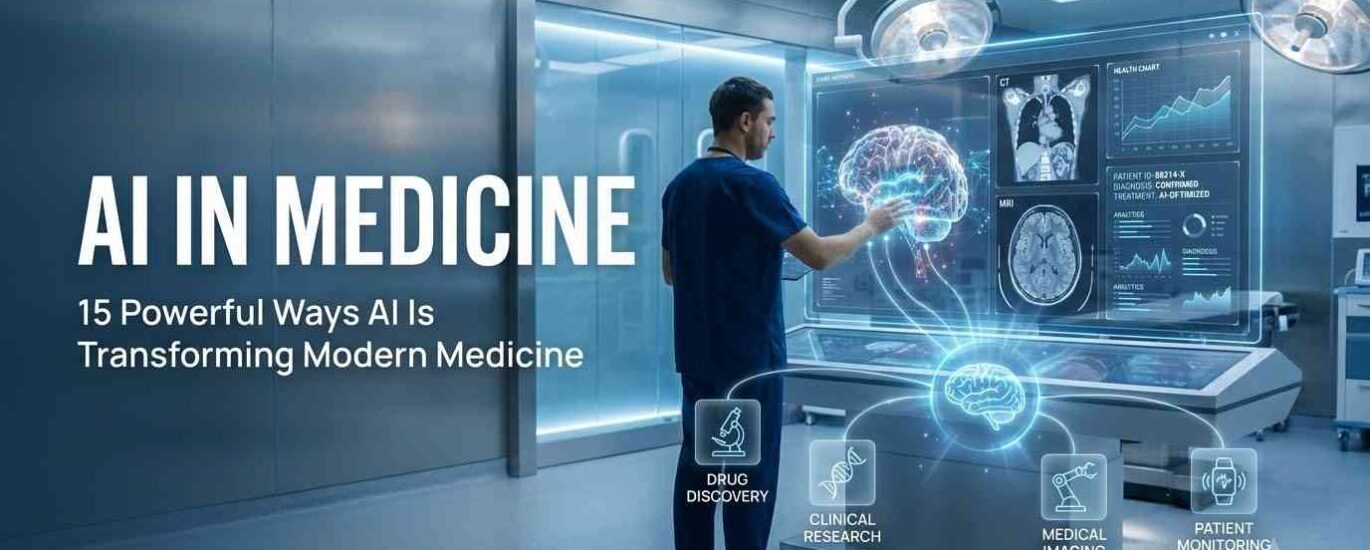
AI in Medicine is changing how doctors, researchers, hospitals and healthcare organizations work with medical information. From medical imaging and diagnosis support to drug discovery, clinical research and administrative automation, artificial intelligence is being applied across many areas of modern medicine.
The technology is developing quickly, but it is important to understand what AI can and cannot do. AI can assist healthcare professionals with specific tasks, analyze large datasets and automate repetitive workflows. It does not automatically replace doctors or eliminate the need for clinical judgment.
If you want to understand the broader role of artificial intelligence across healthcare, read our complete guide to AI in Healthcare.
In this article, we will explore 15 practical applications of AI in Medicine, along with its benefits, limitations, risks and future potential.
Table of Contents
- What Is AI in Medicine?
- How Does AI in Medicine Work?
- 15 Uses of AI in Medicine
- AI Medical Diagnosis
- AI in Medical Imaging
- AI in Drug Discovery
- AI in Clinical Research
- Benefits of Medical AI
- Risks and Challenges
- How Doctors and Healthcare Organizations Can Use AI
- Future of AI in Medicine
- Frequently Asked Questions
What Is AI in Medicine?
AI in Medicine refers to the use of artificial intelligence technologies to support medical research, diagnosis, clinical workflows, healthcare professionals and other activities related to medicine.
AI systems can process large amounts of information and identify patterns within data. Depending on the application, the data may include:
- Medical images
- Electronic health records
- Laboratory information
- Clinical notes
- Medical research papers
- Patient-generated data
- Physiological measurements
- Pharmaceutical and molecular data
Machine learning is one of the major technologies used in medical AI. Some systems are designed for highly specific tasks, while newer generative AI systems can work with text and multiple types of information.
The FDA describes AI as technology that can make predictions, recommendations or decisions based on human-defined objectives and notes its growing intersection with medical products.
How Does AI in Medicine Work?
A simplified medical AI workflow looks like this:
Medical Data → AI Model → Pattern Analysis → Output → Professional Review → Decision
For example, an AI system designed for medical imaging may analyze an image and identify an area that should receive additional attention.
The AI output is then reviewed within the appropriate clinical workflow.
This distinction is important because an AI prediction is not automatically the same thing as a medical diagnosis.
The FDA notes that AI-enabled medical devices can be used for applications including image processing, early disease detection, diagnosis, prognosis, risk assessment and personalized diagnostics.
15 Powerful Uses of AI in Medicine
1. AI Medical Diagnosis
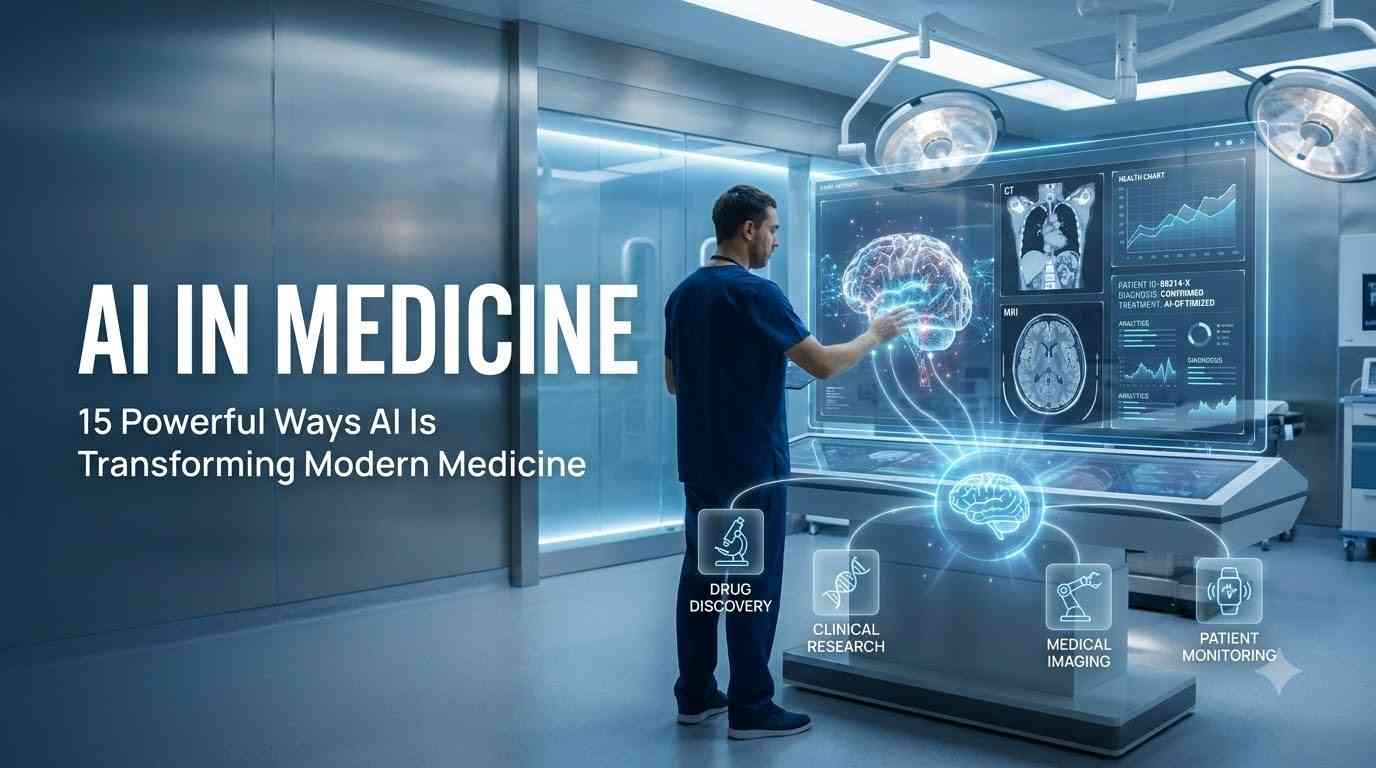
One of the most important applications of AI in Medicine is supporting diagnostic processes.
AI systems can analyze certain medical datasets and identify patterns that may be useful to healthcare professionals.
For example, specialized AI systems may assist with:
- Medical image analysis
- Disease classification
- Risk assessment
- Detection of abnormalities
- Clinical decision support
However, AI should not automatically be treated as a standalone doctor.
A diagnosis normally requires clinical context, patient history, examination, test results and professional judgment.
Research from the National Institutes of Health has also shown why human oversight matters. In one study, an AI model performed well on medical-image questions but still made mistakes when describing images and explaining its reasoning.
2. AI in Medical Imaging
Medical imaging is one of the areas where artificial intelligence has become particularly important.
AI can assist with the analysis of:
- X-rays
- CT scans
- MRI scans
- Ultrasound images
- Mammography
- Other specialized medical images
Depending on the system, AI may help identify patterns, highlight suspicious areas or prioritize images for review.
The FDA maintains a public list of AI-enabled medical devices authorized for marketing in the United States. The agency states that listed devices have met applicable premarket requirements, including evaluation related to safety and effectiveness for their intended use.
This is important because a medical AI tool should not be considered clinically validated simply because it uses artificial intelligence.
3. AI for Early Disease Detection
Another potential application of AI in Medicine is identifying patterns associated with disease at an earlier stage.
AI models can analyze large datasets and look for relationships between measurements, images or other information.
For example, research teams are investigating AI applications that analyze medical scans to identify disease-related patterns.
In March 2026, NIH reported research involving an AI model called Merlin that analyzed 3D abdominal CT scans and performed multiple tasks, including identifying anatomical features and predicting disease-related outcomes in research settings.
Such research is promising, but research performance should not automatically be interpreted as proof that an AI system is ready for every real-world clinical situation.
4. AI in Clinical Decision Support
Doctors often have to process large amounts of medical information.
AI can help organize and summarize information to support clinical workflows.
Potential applications include:
- Summarizing patient records
- Organizing clinical information
- Finding relevant medical literature
- Supporting risk assessment
- Highlighting potentially relevant information
The goal is to help professionals work with information more efficiently.
The final clinical decision should still consider the patient’s complete medical situation and appropriate professional judgment.
5. AI for Medical Documentation
Documentation is an important but time-consuming part of medicine.
AI-powered tools can assist with:
- Transcription
- Clinical note drafting
- Summarizing conversations
- Organizing medical information
- Preparing administrative documentation
Generative AI is increasingly being explored for workflow support, clinical decision support and research. The National Academy of Medicine notes both the potential of generative AI and the need to address risks involving privacy, bias, transparency and infrastructure.
AI-generated documentation should be reviewed before it becomes part of an official medical record.
6. AI in Drug Discovery
Drug discovery can involve analyzing enormous amounts of biological, chemical and scientific information.
AI can help researchers with tasks such as:
- Identifying potential drug candidates
- Analyzing molecular information
- Screening compounds
- Identifying potential targets
- Prioritizing research areas
This does not mean AI can create a safe medicine automatically.
Drug development still requires laboratory research, testing, clinical trials and regulatory review.
AI is better understood as a tool that can accelerate parts of the research process.
7. AI for Medical Research

Researchers need to process huge amounts of scientific information.
AI can help with:
- Literature searches
- Research summaries
- Dataset analysis
- Pattern identification
- Research hypothesis generation
- Information organization
Generative AI can make some research workflows faster, but researchers still need to verify the underlying sources and findings.
An AI-generated summary should not be considered a substitute for reading important scientific evidence.
8. AI for Personalized Medicine
Personalized medicine aims to provide healthcare that takes individual characteristics and circumstances into account.
AI may help analyze multiple data sources and identify patterns that could support personalized approaches.
Potential areas include:
- Risk assessment
- Patient segmentation
- Treatment-response research
- Monitoring
- Personalized communication
However, personalized medical decisions require careful interpretation and appropriate clinical oversight.
9. AI for Patient Monitoring
AI can also be used to analyze information generated through connected devices and monitoring systems.
Potential applications include:
- Remote monitoring
- Chronic disease management
- Health trend detection
- Patient alerts
- Follow-up workflows
AI can help identify changes in data that may require attention, but alert systems need appropriate clinical workflows.
Too many false alerts can create unnecessary workload, while missed alerts can create serious problems.
10. AI for Clinical Trials
Clinical trials generate large amounts of information.
AI can potentially assist researchers with:
- Patient recruitment
- Data analysis
- Trial monitoring
- Identifying patterns
- Research documentation
- Study planning
The objective is to make parts of clinical research more efficient while maintaining appropriate scientific and regulatory standards.
AI can support researchers, but it cannot replace the need for properly designed clinical studies.
11. AI for Medical Knowledge Management
Doctors and medical researchers need access to constantly changing information.
AI can help organize large collections of:
- Research papers
- Medical guidelines
- Clinical documentation
- Educational materials
- Institutional knowledge
This can make information retrieval faster.
However, medical information systems need strong source controls because an AI model can produce incorrect or outdated information.
12. AI for Hospital and Medical Operations
AI in Medicine is not limited to diagnosis.
Hospitals and medical organizations can also use AI for operational tasks such as:
- Scheduling
- Resource planning
- Workflow management
- Inventory forecasting
- Administrative reporting
- Demand prediction
The National Academy of Medicine identifies automation and information synthesis among potential applications of AI in healthcare.
For healthcare organizations, these operational applications can sometimes provide a lower-risk starting point than directly using AI for clinical decisions.
AI in Healthcare: 15 Powerful Ways Artificial Intelligence Is Transforming Healthcare
13. AI for Medical Coding and Administrative Work
Medical organizations handle substantial amounts of administrative information.
AI may assist with:
- Document classification
- Coding support
- Data extraction
- Form processing
- Report generation
- Administrative communication
Automating repetitive administrative tasks can potentially free staff to focus on more complex work.
However, accuracy remains important because errors in administrative information can affect downstream healthcare processes.
14. Generative AI in Medicine
Generative AI has created a new category of medical applications.
Large language models and multimodal AI can potentially assist with:
- Medical information summarization
- Documentation
- Research support
- Patient communication
- Clinical workflow assistance
- Educational content
The National Academy of Medicine says generative AI has potential to support clinical decision-making, streamline workflows, engage patients and support clinical research, while highlighting risks around privacy, bias, transparency and infrastructure.
The important rule is simple:
Use generative AI as an assistant, not as an unquestioned medical authority.
15. AI Automation in Medicine
The combination of AI and workflow automation can create powerful systems for medical organizations.
For example:
Patient Request → AI Classification → Department Assignment → Staff Notification → Follow-Up
Another workflow could be:
Medical Document → AI Extraction → Structured Data → Human Review → Healthcare System
This approach can reduce repetitive manual work while keeping humans involved in important decisions.
Benefits of AI in Medicine

When appropriately implemented, medical AI can provide several potential benefits.
Faster Data Analysis
AI can process large datasets quickly and identify patterns that may be useful for research or clinical workflows.
Reduced Administrative Work
AI automation can reduce repetitive documentation and administrative tasks.
Support for Medical Professionals
AI can assist professionals with information organization and selected clinical or operational tasks.
Faster Research
Researchers can use AI to analyze large collections of scientific information.
Improved Workflow Efficiency
AI can help healthcare organizations optimize selected operational processes.
Better Information Access
AI systems can help organize complex information and make it easier to retrieve.
The National Academy of Medicine describes AI as offering opportunities to improve patient and clinical team outcomes, reduce costs and affect population health, while emphasizing that implementation requires careful consideration.
Can AI Replace Doctors?
No—not completely.
AI can perform specific tasks extremely well, but medicine involves much more than analyzing patterns in data.
Doctors and other healthcare professionals consider:
- Patient history
- Symptoms
- Physical examination
- Test results
- Risk factors
- Medical context
- Patient preferences
- Clinical guidelines
- Treatment options
AI can assist with parts of this process, but professional judgment and accountability remain important.
The FDA also emphasizes that different AI medical applications require different methods for evaluating performance, safety and effectiveness.
What Are the Risks of Medical AI?
The potential of Medical AI comes with important risks.
1. Incorrect Information
AI systems can generate inaccurate or misleading outputs.
2. Bias
AI models can perform differently across populations when the underlying data is incomplete or not representative.
3. Privacy
Medical data can contain highly sensitive personal information.
4. Lack of Transparency
Some AI systems can be difficult to interpret or explain.
5. Changing Performance
AI systems can behave differently when deployed with data that differs from the data used during development.
The FDA specifically notes that changes in patient populations, data sources and clinical environments can affect the performance of AI-enabled medical devices.
6. Regulatory Challenges
Medical AI may be subject to regulatory requirements depending on its intended use and jurisdiction.
WHO has also emphasized the importance of legal, ethical and governance frameworks as AI adoption expands across health systems.
How Should Healthcare Organizations Start Using AI?
Healthcare organizations should not start with:
“Which AI tool should we buy?”
Instead, start with:
“Which problem are we trying to solve?”
A practical five-step approach is:
Step 1: Identify a Problem
Find a repetitive, expensive or time-consuming workflow.
Step 2: Define the Goal
For example:
- Reduce documentation time
- Improve scheduling
- Speed up information retrieval
- Reduce administrative workload
Step 3: Start With a Small Pilot
Test the AI system on a controlled workflow before expanding its use.
Step 4: Keep Human Oversight
Important medical decisions should have appropriate professional review.
Step 5: Measure Performance
Track:
- Accuracy
- Time saved
- Cost
- Error rate
- User satisfaction
- Workflow improvement
If the AI system does not create measurable value, the organization should reconsider the implementation.
AI in Medicine vs AI in Healthcare
The terms AI in Medicine and AI in Healthcare are closely related, but they are not exactly the same.
| AI in Medicine | AI in Healthcare |
|---|---|
| More focused on medical and clinical applications | Broader healthcare ecosystem |
| Diagnosis support | Patient services |
| Medical imaging | Hospital administration |
| Drug discovery | Healthcare marketing |
| Clinical research | Scheduling |
| Clinical decision support | Data management |
| Medical documentation | Operational automation |
This is why an AI in Medicine article can support your broader AI in Healthcare pillar article without simply duplicating it.
What Is the Future of AI in Medicine?
The future of AI in Medicine will likely involve deeper integration between AI systems, medical devices, clinical software, research platforms and healthcare workflows.
Specialized AI systems may continue to expand in areas such as medical imaging, diagnosis support, research and operational automation.
Generative AI may also become increasingly useful for documentation, information retrieval and research workflows.
At the same time, safety and evaluation will become more important.
The FDA continues to research how AI-enabled medical devices should be evaluated and monitored in real-world settings, including changes in data and model performance.
Therefore, the future of medical AI is not simply about creating more powerful models.
It is about building systems that are:
Accurate + Safe + Transparent + Secure + Clinically Useful + Properly Regulated
Frequently Asked Questions
What is AI in Medicine?
AI in Medicine means using artificial intelligence to support medical research, diagnosis-related tasks, clinical workflows, medical information processing and other activities related to medicine.
How is AI used in medicine?
AI is being used or researched for medical imaging, diagnosis support, drug discovery, clinical research, documentation, patient monitoring, medical knowledge management and healthcare operations.
What is Medical AI?
Medical AI refers to artificial intelligence technologies designed or used for medical and healthcare-related applications.
Can AI diagnose diseases?
Some AI systems are designed to assist with specific diagnostic tasks. However, AI output should not automatically be considered a medical diagnosis and should be interpreted within the appropriate clinical context.
Can AI replace doctors?
AI can assist doctors with specific tasks, but it cannot replace the full range of clinical judgment, communication, examination and accountability required in medicine.
What are the benefits of AI in Medicine?
Potential benefits include faster data analysis, reduced administrative workload, research support, improved workflow efficiency and assistance with selected clinical tasks.
What are the risks of AI in Medicine?
Important risks include inaccurate outputs, bias, privacy concerns, lack of transparency, cybersecurity issues, changing model performance and regulatory challenges.
Is Medical AI safe?
Safety depends on the specific AI system, its intended use, validation, implementation and monitoring. Medical AI should be evaluated for its particular application rather than assumed to be safe simply because it uses AI.
Conclusion
AI in Medicine is becoming an important part of modern medical research, clinical technology and healthcare operations.
AI can help analyze medical information, support medical imaging, assist with diagnosis-related tasks, accelerate research, support drug discovery and automate repetitive workflows.
But the technology has limitations.
AI can make mistakes, reflect bias in its data and produce outputs that require professional interpretation. Medical organizations therefore need to evaluate AI systems carefully and maintain appropriate human oversight.
The most practical approach is not to ask whether AI will replace medicine.
Instead, ask:
Which medical or healthcare task can AI perform more efficiently while maintaining safety, accuracy and human oversight?
That is where the real value of AI in Medicine is likely to come from.