
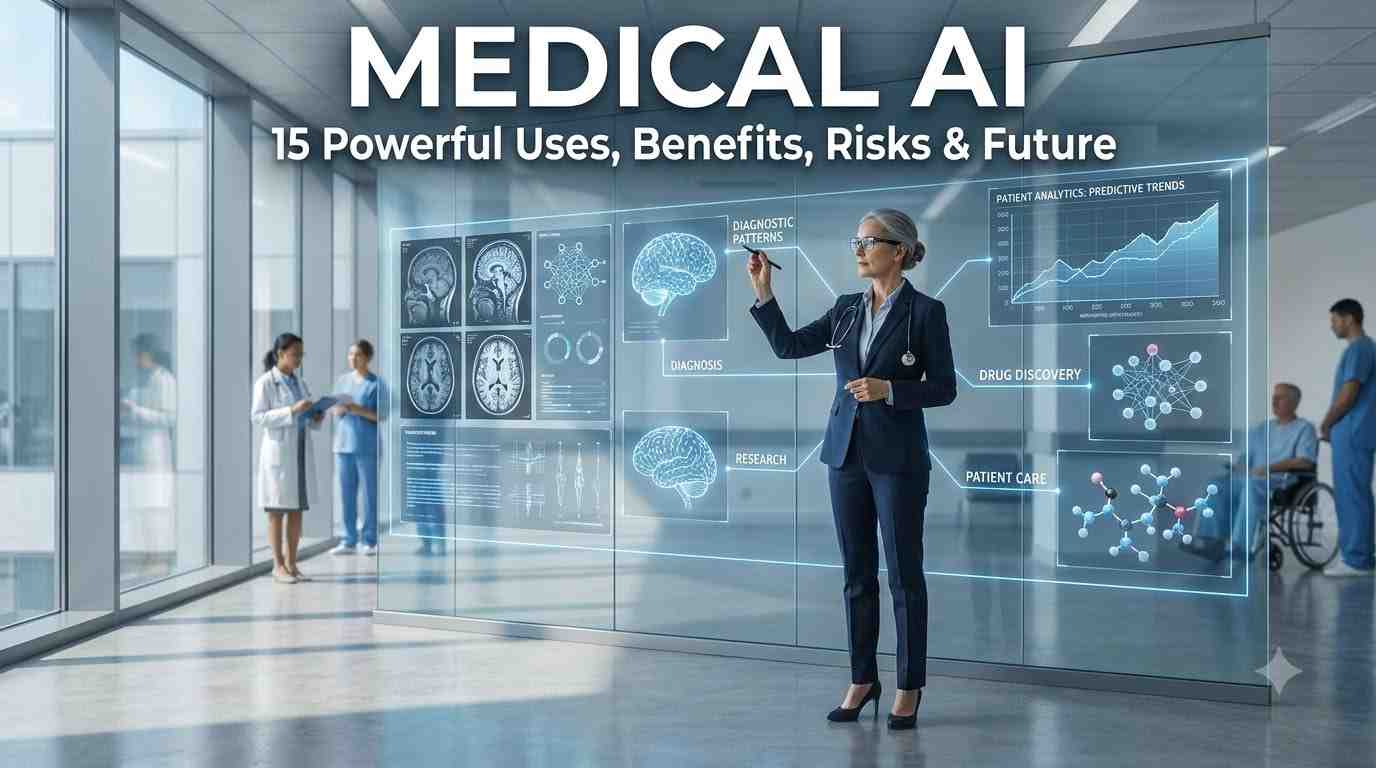
Medical AI: 15 Powerful Uses, Benefits, Risks & Future of AI in Medicine
A doctor has only so many hours in a day. A radiologist may need to review hundreds of images. A researcher may have thousands of scientific papers to examine. A hospital may have millions of pieces of administrative and clinical data.
This is where Medical AI becomes interesting.
Artificial intelligence can process large amounts of information, identify patterns and assist with specific healthcare tasks. It is already being explored and used across medical imaging, diagnosis support, research, drug development, documentation and healthcare operations.
But there is a side of Medical AI that is often missing from the hype.
AI can be impressive and still be wrong.
A system may identify a useful pattern but misunderstand the context. A chatbot may produce a confident answer that contains an error. A model that performs well in one hospital may perform differently somewhere else.
That is why the future of Medical AI is not simply about making AI more powerful. It is about making it useful, safe, transparent and properly supervised.
If you want to understand the broader use of artificial intelligence across the healthcare industry, read our guide to AI in Healthcare.
For a more medicine-focused overview, see our article on AI in Medicine.
Table of Contents
- What Is Medical AI?
- How Does Medical AI Work?
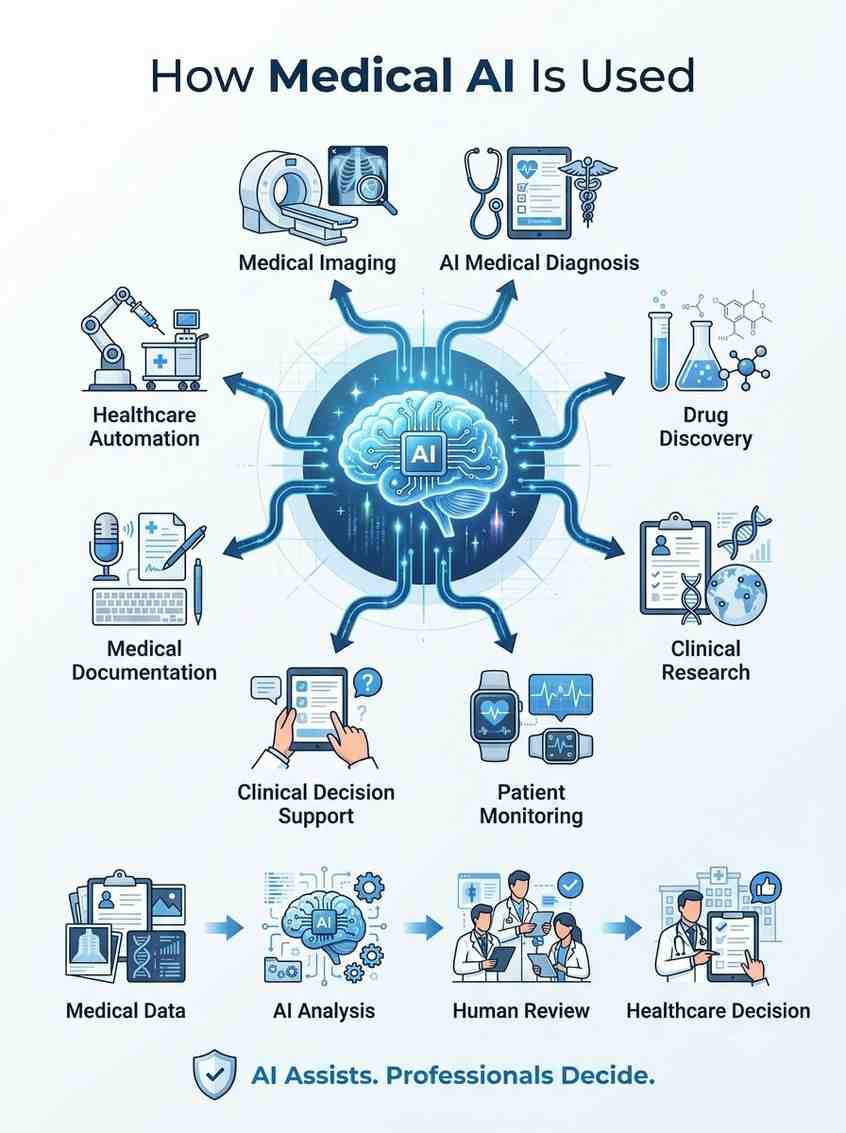
- 15 Uses of Medical AI
- Real-World Examples
- Benefits of Medical AI
- Medical AI vs Traditional Healthcare
- Risks and Limitations
- How to Evaluate a Medical AI Tool
- Can Medical AI Replace Doctors?
- Future of Medical AI
- Frequently Asked Questions
What Is Medical AI?
Medical AI refers to artificial intelligence technologies that are designed or used to support medical and healthcare-related tasks.
Depending on the application, a Medical AI system may work with:
- Medical images
- Patient records
- Laboratory data
- Clinical notes
- ECG and other physiological signals
- Scientific literature
- Molecular and pharmaceutical data
- Administrative information
Some systems are highly specialized.
For example, one AI model may be designed to analyze a specific type of medical image. Another may assist with documentation. A different system may be developed for pharmaceutical research.
So when someone says “Medical AI,” it does not necessarily mean a single AI that can diagnose every disease.
It is better to think of Medical AI as an ecosystem of specialized technologies.
The FDA maintains a public list of AI-enabled medical devices authorized for marketing in the United States. These devices have met applicable premarket requirements, including evaluation related to safety and effectiveness for their intended use.
How Does Medical AI Work?
A simple Medical AI workflow can look like this:
Medical Data → AI Model → Pattern Recognition → AI Output → Human Review → Action
Imagine a radiology department.
A scan arrives.
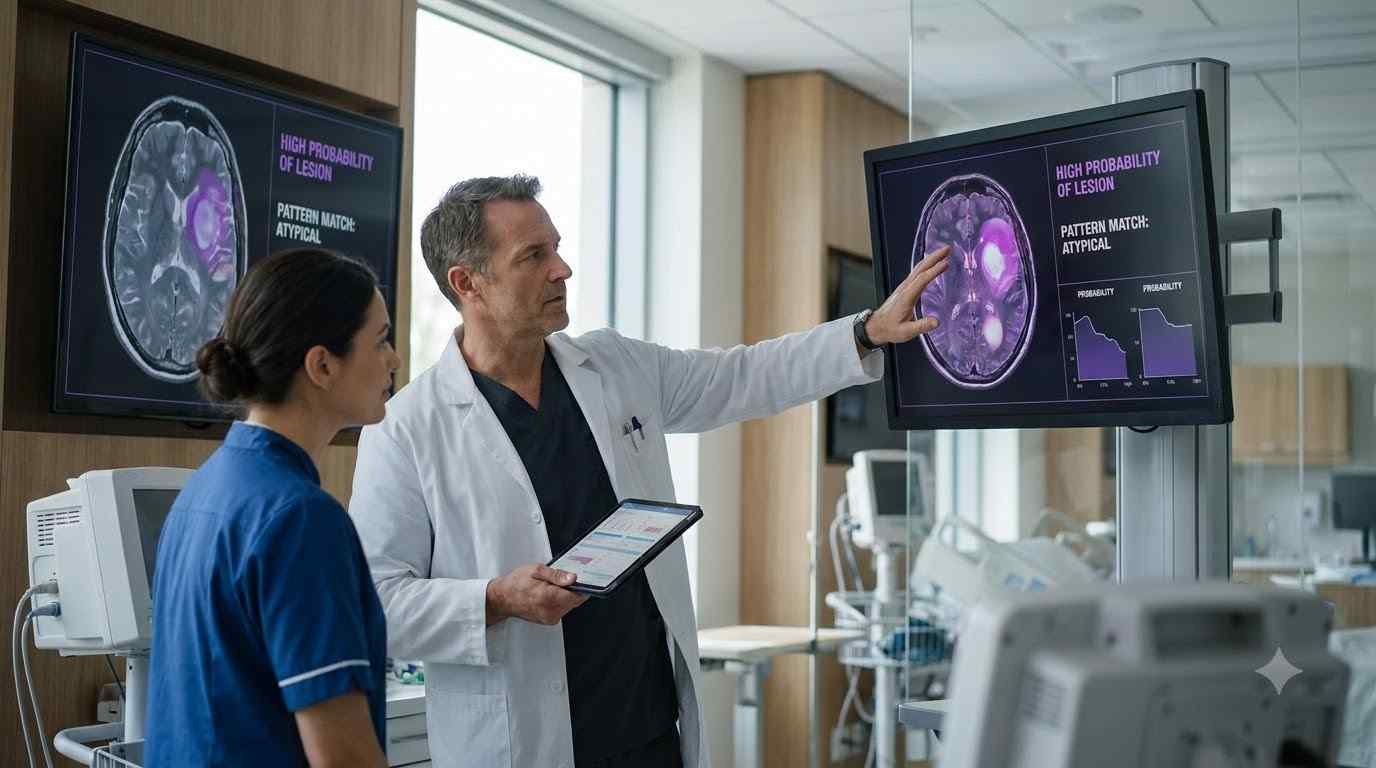
An AI system analyzes it and identifies an area that may require attention.
The radiologist then reviews the original scan, the AI output and the patient’s relevant clinical information.
The AI has assisted the process.
It has not necessarily replaced the radiologist.
This distinction is extremely important when evaluating AI in medicine.
The FDA notes that AI-enabled medical devices can have very different intended uses, including diagnosis, triage, prognosis, risk assessment and treatment-response prediction. Different uses require different evaluation approaches.
15 Powerful Uses of Medical AI
1. Medical Imaging
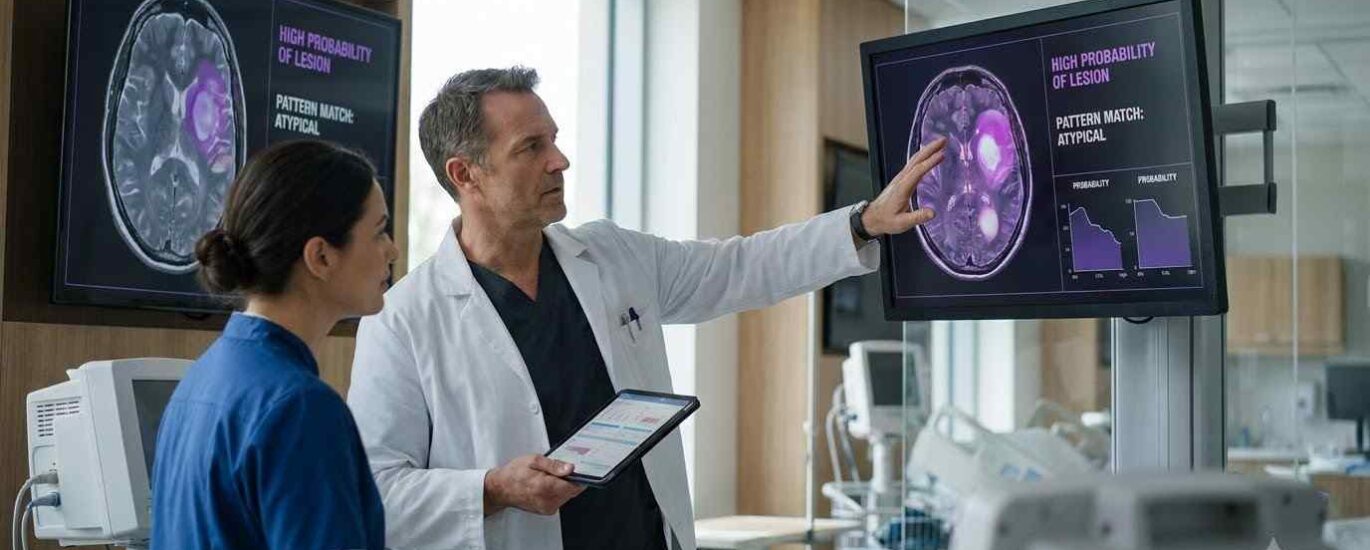
Medical imaging is one of the most established areas for healthcare AI.
Medical AI can be used in systems that analyze:
- X-rays
- CT scans
- MRI scans
- Mammograms
- Ultrasound
- Pathology images
Depending on the specific technology, AI may highlight areas for review, classify findings or assist with workflow prioritization.
This does not mean every AI image-analysis tool is clinically reliable.
The important question is:
What was this particular system designed, tested and authorized to do?
The FDA’s AI-enabled medical device list is useful for understanding that distinction.
2. AI Medical Diagnosis
One of the biggest areas of interest is AI-assisted diagnosis.
Medical AI can analyze certain datasets and identify patterns associated with particular conditions.
For example, an AI system may assist with:
- Image interpretation
- Abnormality detection
- Risk assessment
- Clinical decision support
- Disease classification
But a medical diagnosis is not just a pattern-recognition exercise.
A doctor also considers symptoms, history, examination findings, test results and the patient’s circumstances.
That is why AI-assisted diagnosis is a better way to understand many current applications than the idea of a completely autonomous AI doctor.
3. AI in Medical Research
Medical research generates enormous amounts of information.
Researchers can use AI to help:
- Search scientific literature
- Summarize information
- Analyze datasets
- Identify patterns
- Generate research hypotheses
- Organize research findings
AI can make some research workflows faster.
But speed should not replace scientific verification.
A researcher still needs to check the original evidence, methodology and limitations.
4. Drug Discovery
Developing a new drug can require years of research and substantial investment.
AI can help researchers analyze molecular structures, biological data and potential drug candidates.
Potential applications include:
- Molecule screening
- Drug-target identification
- Compound analysis
- Research prioritization
- Predictive modeling
AI does not eliminate laboratory experiments or clinical trials.
Instead, it can potentially help researchers decide where to focus their time and resources.
WHO identifies drug development as one of the areas where AI has significant potential.
5. Clinical Documentation
Doctors and other healthcare professionals spend significant time creating documentation.
AI-powered systems can assist with:
- Transcription
- Note drafting
- Summarization
- Information organization
- Administrative documentation
Imagine a doctor finishing a patient consultation and having an AI system create a draft summary.
The doctor can review and correct it instead of starting the document from a blank page.
That is a practical use of AI.
However, the generated content should be reviewed before becoming part of an official medical record.
6. Patient Communication
Medical organizations are also exploring AI for routine patient communication.
Possible applications include:
- Appointment information
- Reminders
- Frequently asked questions
- Healthcare navigation
- Basic administrative support
A chatbot can be useful for answering:
“What documents should I bring to my appointment?”
It is a very different situation when someone asks:
“What is causing my chest pain?”
The second question requires a much higher level of clinical caution.
WHO warns that AI systems can produce convincing but incorrect health information and recommends rigorous evaluation and expert supervision.
7. Remote Patient Monitoring
Medical AI can analyze information collected through connected devices and monitoring systems.
Depending on the system, AI may help identify trends in:
- Heart rate
- Blood pressure
- Glucose measurements
- Oxygen saturation
- Other health-related signals
The goal is not necessarily to make an automatic diagnosis.
It can be to identify changes that deserve attention.
8. Personalized Healthcare
Patients are not identical.
Two people with the same diagnosis may have different histories, risk factors and treatment responses.
AI can potentially analyze multiple data sources to support more personalized approaches.
Possible applications include:
- Risk assessment
- Patient segmentation
- Treatment-response research
- Monitoring
- Personalized communication
However, personalized healthcare requires reliable data and appropriate professional interpretation.
9. Medical Coding and Administrative Automation
Not every Medical AI application is clinical.
Healthcare organizations also have large administrative workloads.
AI can assist with:
- Document classification
- Data extraction
- Coding support
- Form processing
- Report generation
- Administrative workflows
These applications can sometimes be a practical starting point because the AI is assisting a process rather than directly making a clinical decision.
10. Clinical Decision Support
Doctors have to work with huge amounts of information.
AI can help organize information and highlight potentially relevant details.
For example:
Patient record → AI summary → Relevant information highlighted → Doctor reviews
AI can potentially reduce information overload.
But it should not become an unquestioned source of truth.
WHO’s 2026 work on AI and health policy emphasizes that AI should augment rather than replace human judgment and recommends human verification and human-in-the-loop decision points.
11. Medical Knowledge Management
Medical knowledge changes continuously.
Healthcare organizations may use AI to organize:
- Research papers
- Guidelines
- Internal documentation
- Clinical information
- Educational materials
AI can make information easier to search and summarize.
However, medical professionals need to know whether the information is current and where it came from.
An AI-generated summary should not automatically be treated as a medical guideline.
12. Disease Surveillance
AI can analyze large datasets to identify patterns associated with disease trends and public health events.
Potential applications include:
- Disease surveillance
- Outbreak analysis
- Population health monitoring
- Public health research
WHO identifies disease surveillance and outbreak response among the areas where AI can support public health.
13. AI in Pathology
Digital pathology creates opportunities for AI-assisted analysis of tissue images.
Medical AI can potentially help identify patterns in pathology slides and highlight regions that require closer review.
This can be useful because digital pathology images can contain enormous amounts of information.
Again, AI should be evaluated for the specific task it is being used for.
14. AI for Medical Training
AI can also support education and training.
Medical students and healthcare professionals can use AI-based systems for:
- Practice questions
- Case simulations
- Explanation of medical concepts
- Study assistance
- Research support
But educational AI has the same problem as general AI:
A confident answer can still be wrong.
Students should verify important medical information using trusted educational resources and professional guidance.
15. Generative AI in Medicine
Generative AI has expanded the possibilities for Medical AI.
These systems can generate:
- Text
- Summaries
- Draft documentation
- Explanations
- Research assistance
- Patient communication drafts
Multimodal AI can work with multiple types of input, which could expand healthcare applications further.
WHO’s guidance on large multimodal models notes potential applications across healthcare, scientific research, public health and drug development while also emphasizing risks and governance requirements.
A Real-World Way to Think About Medical AI
Let’s take a simple example.
Suppose a hospital receives 500 medical scans in a day.
Without AI:
500 scans → Manual workflow → Specialist review
With an appropriately validated AI system:
500 scans → AI analysis → Potentially prioritized findings → Specialist review
The specialist is still there.
The AI has become another layer in the workflow.
This is often a more realistic and useful way to think about Medical AI than the idea that AI will simply “replace doctors.”
Medical AI: What It Can Do vs What It Cannot Reliably Do
| AI Can Potentially Help With | AI Should Not Be Treated As |
|---|---|
| Analyze specific medical images | A universal doctor |
| Summarize medical information | A guaranteed source of truth |
| Assist documentation | A replacement for clinical judgment |
| Analyze large datasets | A substitute for patient examination |
| Support research | A replacement for clinical trials |
| Assist selected diagnostic tasks | An automatic diagnosis for every condition |
| Automate administrative workflows | A system that needs no human oversight |
This distinction is especially important for patients.
Benefits of Medical AI
Faster Information Processing
AI can process large datasets much faster than manual workflows.
Reduced Repetitive Work
Documentation and administrative tasks can potentially be streamlined.
Research Support
Researchers can analyze large datasets and scientific literature more efficiently.
Workflow Assistance
AI can help organize information and support specific healthcare processes.
Potential Diagnostic Support
Specialized AI systems may assist with specific diagnostic tasks.
Improved Access to Information
AI can make large amounts of information easier to search and summarize.
WHO recognizes potential benefits across diagnosis, treatment, research, drug development and public health, while stressing that benefits depend on responsible design and use.
The Biggest Problems With Medical AI
The technology has genuine limitations.
1. AI Can Be Wrong
An AI system may produce an incorrect answer with a confident tone.
That makes healthcare AI particularly sensitive.
2. Bias in Data
If the data used to train or validate an AI system is not representative, performance can vary across populations.
3. Privacy
Healthcare information can be highly sensitive.
Organizations need strong controls around:
- Data access
- Storage
- Security
- Consent
- Third-party processing
4. Lack of Transparency
Some AI systems can be difficult to interpret.
Healthcare professionals need to understand the system’s intended use and limitations.
5. Changing Performance
A model may perform differently when used with new populations, equipment or workflows.
6. Overreliance on AI
Perhaps the biggest human risk is assuming:
“The computer said it, so it must be correct.”
That is exactly the mindset healthcare organizations should avoid.
WHO has repeatedly emphasized transparency, human autonomy, safety, accountability and equity when deploying AI for health.
Can Medical AI Replace Doctors?
Not in the way many headlines suggest.
A doctor does more than analyze data.
A doctor:
- Talks to the patient
- Understands the patient’s story
- Performs examinations
- Interprets symptoms
- Weighs uncertainty
- Discusses treatment options
- Considers patient preferences
- Takes clinical responsibility
AI can assist with parts of this process.
But medicine is not just a data-processing problem.
WHO’s 2026 guidance makes the same fundamental point: AI should strengthen human judgment rather than remove it.
How to Evaluate a Medical AI Tool
If a hospital, clinic or healthcare business is considering an AI system, don’t start by asking:
“How advanced is the AI?”
Ask these questions instead.
1. What exactly does it do?
Avoid vague claims such as “AI-powered healthcare.”
Find the exact intended use.
2. What evidence supports it?
Look for validation studies and appropriate evidence.
3. Who was it tested on?
A system’s performance can vary across populations.
4. What happens when it is wrong?
There should be a clear human-review process.
5. How is patient data handled?
Review privacy, security and data-processing policies.
6. Is it regulated or authorized for its intended use?
For medical devices, check the relevant regulatory authority.
In the United States, the FDA’s AI-enabled medical device list provides a useful starting point for identifying devices authorized for marketing.
7. How is performance monitored?
A healthcare organization should not assume that initial validation guarantees permanent performance.
Medical AI and Trust
Trust is one of the biggest issues in healthcare AI.
Imagine two systems.
System A
“The AI says the patient has condition X.”
No explanation. No evidence. No indication of uncertainty.
System B
“The AI identified a finding that may require review. The clinician can inspect the original data and compare it with the patient’s clinical information.”
System B is easier to integrate into a responsible healthcare workflow because it keeps the professional involved.
WHO has specifically warned that AI-generated health information can appear authoritative even when it is incorrect, making transparency, expert supervision and rigorous evaluation particularly important.
Medical AI vs AI in Healthcare vs AI in Medicine
These terms overlap, but their search intent can be slightly different.
| Topic | Main Focus |
|---|---|
| Medical AI | AI technologies used for medical applications |
| AI in Medicine | How AI is changing medical practice and research |
| AI in Healthcare | Broader healthcare ecosystem, including operations and patient services |
This is why all three topics can exist on a website without being duplicate articles.
For a broader overview, read AI in Healthcare.
For the medical-practice perspective, read AI in Medicine.
How Healthcare Organizations Can Start With Medical AI
A healthcare organization does not need to automate everything.
A safer approach is to start with one clearly defined problem.
Step 1: Find a Repetitive Task
For example:
- Documentation
- Scheduling
- Report preparation
- Data organization
Step 2: Define Success
What should improve?
- Time
- Cost
- Accuracy
- Staff workload
- Patient experience
Step 3: Choose the Right Tool
Select technology based on the problem, not marketing claims.
Step 4: Run a Pilot
Start with a limited workflow.
Step 5: Keep Human Oversight
Define who reviews AI output and when.
Step 6: Monitor Results
Track real-world performance.
Step 7: Scale Only After Evidence
If the system works, expand it.
WHO’s regulatory guidance recommends attention to intended use, external validation, data quality, transparency, cybersecurity and ongoing risk management.
What Is the Future of Medical AI?
Medical AI will likely become more specialized rather than simply becoming a single “AI doctor.”
We may see more systems designed for:
- Medical imaging
- Clinical documentation
- Drug discovery
- Patient monitoring
- Medical research
- Clinical decision support
- Healthcare operations
- Multimodal data analysis
Generative and multimodal AI may broaden the range of tasks that software can perform, but this will also increase the importance of validation and governance.
WHO’s latest work emphasizes that AI adoption needs human verification, multidisciplinary oversight and risk-based governance.
In other words, the future is not just:
Better AI
It is:
Better AI + Better Evidence + Better Oversight
Frequently Asked Questions
What is Medical AI?
Medical AI is the use of artificial intelligence technologies to support medical tasks such as medical imaging, diagnosis-related workflows, research, documentation, drug discovery and other healthcare applications.
Is Medical AI the same as AI in Healthcare?
They overlap, but Medical AI generally has a stronger medical and clinical focus, while AI in Healthcare is a broader concept covering clinical, administrative, operational and patient-service applications.
How is Medical AI used?
Medical AI can be used for medical imaging, diagnostic support, research, drug discovery, documentation, patient monitoring, pathology, clinical decision support and administrative automation.
Can Medical AI diagnose diseases?
Some specialized AI systems can assist with specific diagnostic tasks. However, AI output should not automatically be treated as a final diagnosis.
Can Medical AI replace doctors?
Medical AI can assist doctors with selected tasks, but it does not replace the full range of clinical judgment, examination, communication and accountability involved in medical care.
Is Medical AI safe?
Safety depends on the specific technology, intended use, validation, deployment and monitoring. AI should not be assumed to be safe simply because it uses advanced technology.
What are the biggest risks of Medical AI?
Major concerns include inaccurate outputs, bias, privacy, cybersecurity, lack of transparency, changing performance and overreliance on AI.
What should hospitals check before adopting AI?
Hospitals should evaluate the intended use, evidence, validation, data privacy, security, regulatory status where applicable, human oversight and real-world performance monitoring.
Conclusion
Medical AI has moved beyond science fiction.
AI-enabled technologies are already being developed and used across areas such as medical imaging, diagnostic support, research, drug development, documentation and healthcare operations.
But the most useful way to understand Medical AI is not:
“AI will replace doctors.”
A more realistic picture is:
AI handles specific tasks → professionals review the output → humans make important decisions.
That approach recognizes both sides of the technology.
AI can process enormous amounts of information and automate repetitive work. At the same time, it can make mistakes, reflect bias and produce convincing but incorrect information.
The healthcare industry therefore needs more than powerful AI.
It needs trustworthy AI.
That means appropriate validation, good data, privacy protection, transparency, regulation, human oversight and continuous monitoring.
The future of Medical AI will ultimately be decided not by how impressive the technology looks, but by whether it can create measurable value while keeping patients safe and people in control.