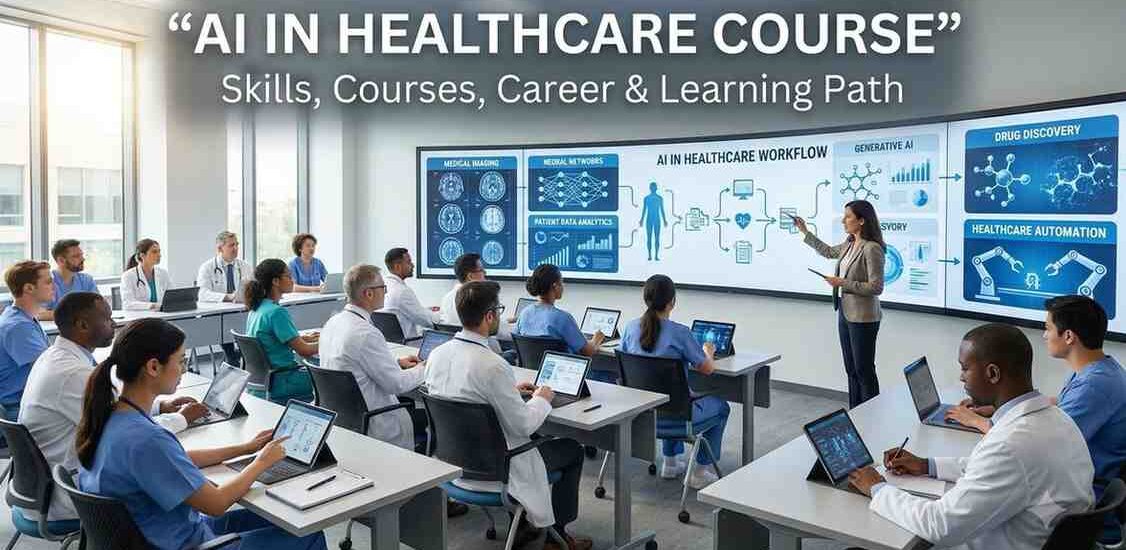
AI in Healthcare Course: 15 Best Ways to Learn AI for Healthcare
An AI in Healthcare Course can look very different depending on who is taking it.
A doctor may want to understand how AI can support diagnosis and clinical workflows.
A healthcare manager may want to learn how AI can reduce administrative work.
A data professional may want to build machine-learning models using healthcare data.
And a complete beginner may simply want to understand what all the AI hype actually means before spending money on a course.
These people do not need the same training.
That is why choosing an AI in Healthcare Course should not start with the question, “Which course is the most popular?”
A better question is:
“What do I actually want to do with AI in healthcare?”
Healthcare organizations are increasingly looking for professionals who can work with digital health technologies, including artificial intelligence. WHO says future health and care workers will need additional digital competencies, including the ability to use AI tools and analyze new evidence.
If you are completely new to the subject, first read our guide to AI in Healthcare.
For the medical side, you can also read AI in Medicine, our practical guide to Medical AI, and AI in Medical Field.
Table of Contents
- What Is an AI in Healthcare Course?
- Who Should Take an AI Healthcare Course?
- 15 Things You Should Learn
- Do You Need Coding?
- Best AI Healthcare Course Path for Beginners
- What Should a Good Course Teach?
- Certification vs Real Skills
- How Much Does an AI Healthcare Course Cost?
- Online vs University Courses
- Career Opportunities
- How to Choose the Right Course
- Common Mistakes
- Frequently Asked Questions
What Is an AI in Healthcare Course?
An AI in Healthcare Course teaches students how artificial intelligence is applied to healthcare and medicine.
Depending on the program, the curriculum may cover:
- Artificial intelligence fundamentals
- Machine learning
- Healthcare data
- Medical imaging
- Clinical decision support
- Generative AI
- Healthcare automation
- Data privacy
- AI ethics
- Healthcare regulations
- Medical research
- AI implementation
Some courses are designed for healthcare professionals and require little or no programming.
Others are much more technical and teach machine learning, Python, data analysis and model development.
That difference is extremely important.
A nurse who wants to understand AI does not necessarily need the same curriculum as a software engineer who wants to build medical AI systems.
Why Are AI Healthcare Courses Becoming Important?
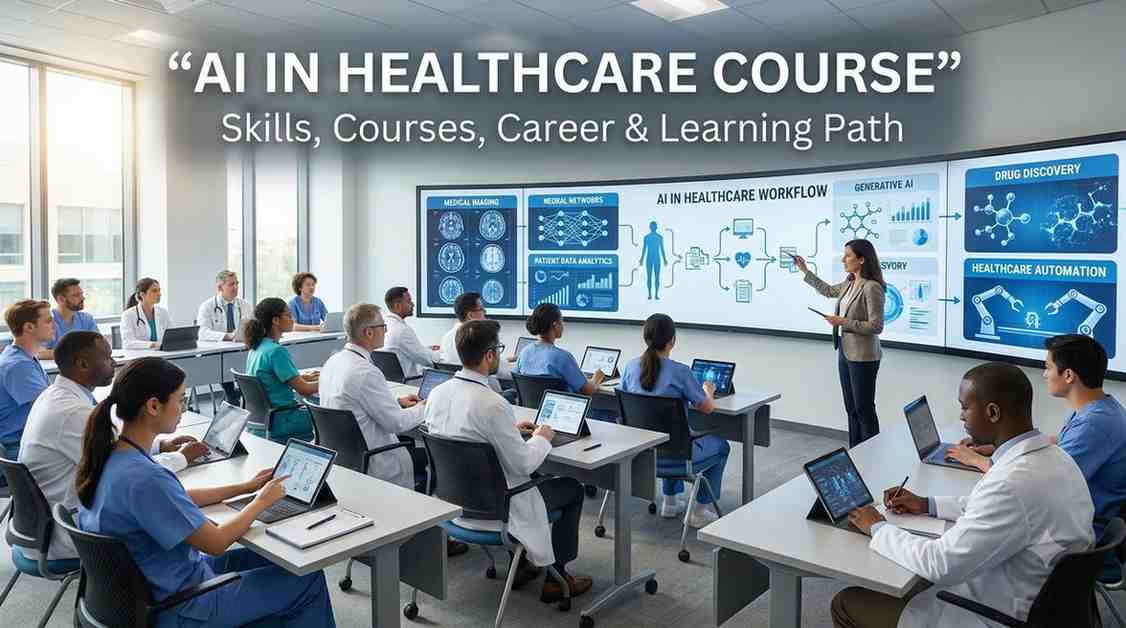
Healthcare is becoming increasingly digital.
Hospitals, research organizations, pharmaceutical companies and health-tech businesses are working with larger amounts of data and increasingly sophisticated software.
At the same time, AI is being introduced into areas such as medical imaging, documentation, research, clinical workflows and healthcare operations.
That creates a new problem:
Healthcare professionals need to understand AI even if they are not AI engineers.
A recent systematic review of AI education for healthcare workers found that training programs can improve AI literacy, knowledge and skills, although many existing programs remain relatively short and introductory.
This suggests that simply completing a short introductory course may not be enough for someone who wants advanced AI expertise.
Who Should Take an AI in Healthcare Course?
An AI healthcare course can be useful for several groups.
Doctors
Doctors may want to understand:
- AI-assisted diagnosis
- Medical imaging
- Clinical decision support
- Generative AI
- AI limitations
- Patient safety
The goal does not have to be learning programming.
It can simply be learning how to evaluate and use AI responsibly.
Nurses and Allied Healthcare Professionals
Nurses, technicians and other healthcare professionals increasingly interact with digital systems.
An AI course can help them understand:
- AI terminology
- Healthcare automation
- AI-assisted workflows
- Data interpretation
- Privacy
- Ethical issues
Healthcare Managers
Managers may be more interested in implementation than algorithms.
They may want to learn:
- Where AI can save time
- How to evaluate AI vendors
- How to measure ROI
- Data governance
- Implementation risks
- Staff training
Medical Students
Medical students have a unique opportunity because AI skills can be developed before entering full-time clinical practice.
Recent research into medical education shows growing interest in AI-assisted clinical skills training, including virtual patients, simulation, documentation and clinical reasoning tools.
Data Scientists and Developers
This group usually needs a much deeper technical course.
They may need:
- Python
- Statistics
- Machine learning
- Deep learning
- Data preprocessing
- Model evaluation
- Healthcare datasets
- Computer vision
- Natural language processing
- Model deployment
This is a completely different learning path from a beginner healthcare AI course.
15 Things You Should Learn in an AI in Healthcare Course
A good program should cover more than just “how ChatGPT works.”
1. AI Fundamentals
Start with the basics.
You should understand:
- Artificial intelligence
- Machine learning
- Deep learning
- Generative AI
- Large language models
- Computer vision
You do not need to become a mathematician to understand these concepts.
You need to understand what they do and where they are useful.
2. Machine Learning in Healthcare
Machine learning is an important part of modern healthcare AI.
A course may introduce:
- Supervised learning
- Unsupervised learning
- Classification
- Regression
- Prediction
- Model evaluation
The healthcare context matters.
A model that predicts something in a financial dataset is very different from one used with patient information.
3. Healthcare Data
AI is only as useful as the data and workflow around it.
A good course should explain healthcare data such as:
- Electronic health records
- Medical images
- Laboratory data
- Clinical notes
- Patient monitoring data
You should also understand that healthcare data can be incomplete, inconsistent and biased.
4. AI Medical Diagnosis
A healthcare AI course should explain how AI can support specific diagnostic tasks.
This can include:
- Medical imaging
- Pattern recognition
- Risk prediction
- Decision support
But it should also explain limitations.
A responsible course should never teach students that AI automatically replaces doctors.
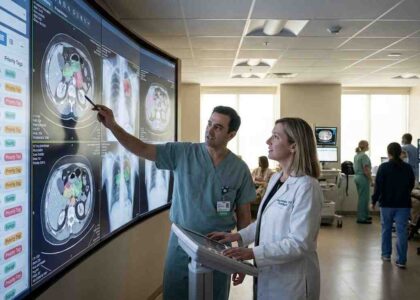
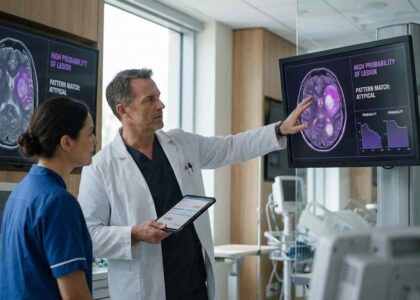
5. Medical Imaging AI
Medical imaging is one of the most important areas of healthcare AI.
Courses may introduce AI applications involving:
- X-rays
- CT
- MRI
- Ultrasound
- Pathology images
The goal may be to understand how computer vision models can process images and identify patterns.
6. Generative AI
Modern healthcare training should also cover generative AI.
Topics can include:
- Large language models
- AI assistants
- Medical documentation
- Summarization
- Research support
- Patient communication
- Prompt design
However, students should also learn that generative AI can produce incorrect information.
7. AI Ethics
This is not an optional topic.
Healthcare AI affects real people.
A good course should discuss:
- Bias
- Fairness
- Privacy
- Transparency
- Accountability
- Human oversight
WHO’s AI-for-health framework emphasizes that AI should be safe, ethical and equitable, with appropriate governance and regulation.
8. Healthcare Privacy and Data Security
Healthcare information can be highly sensitive.
Students should understand why AI systems need appropriate controls around:
- Patient information
- Data access
- Data storage
- Security
- Third-party tools
A course that teaches people to upload confidential patient information into random AI tools without considering privacy is not teaching responsible AI.
9. AI in Medical Research
AI can help researchers work with large collections of scientific information.
A course may teach:
- Research data analysis
- Literature review
- AI-assisted research
- Predictive modeling
- Scientific information management
But students should learn to verify AI-generated information against original research.
10. AI in Drug Discovery
Pharmaceutical companies are exploring AI for areas such as:
- Molecular analysis
- Drug candidate screening
- Drug-target prediction
- Research prioritization
This is a useful topic for students interested in pharmaceutical technology.
11. Clinical Decision Support
AI can organize information and provide decision-support outputs.
A course should explain:
AI output ≠ automatic medical decision
The healthcare professional still needs to evaluate the output.
12. Healthcare Automation
Not every healthcare AI application involves diagnosis.
AI can automate or assist with:
- Documentation
- Scheduling
- Administrative tasks
- Data extraction
- Reporting
- Patient communication
For healthcare managers, this can sometimes be more immediately useful than advanced machine learning.
13. AI Evaluation
This is one of the most important skills.
You should learn how to ask:
- How accurate is the model?
- What data was used?
- Who was it tested on?
- What are the failure cases?
- Does performance change across populations?
- How is the model monitored?
Without evaluation skills, learning AI tools can create false confidence.
14. AI Governance and Regulation
Healthcare AI cannot be treated exactly like ordinary consumer software.
Students should understand the importance of:
- Intended use
- Validation
- Risk assessment
- Regulatory requirements
- Documentation
- Monitoring
A good course should teach students to ask “Is this appropriate for healthcare?”, not just “Does this AI tool work?”
15. Real-World AI Projects
This is where a course becomes much more valuable.
Instead of only watching videos, students should ideally work on practical projects.
For example:
Project 1: Analyze a healthcare dataset.
Project 2: Build a simple prediction model.
Project 3: Create an AI documentation workflow.
Project 4: Analyze medical images using an existing model.
Project 5: Design an AI implementation plan for a hospital.
Projects demonstrate actual skills much better than a certificate alone.
Do You Need Coding for an AI in Healthcare Course?

Not always.
This is one of the biggest misconceptions.
There are roughly three levels.
Level 1 — AI Literacy
No coding required
Suitable for:
- Doctors
- Nurses
- Managers
- Healthcare students
- Beginners
Focus:
AI concepts, applications, ethics and responsible use.
Level 2 — AI Application
Basic technical knowledge helpful
Focus:
- Data analysis
- AI tools
- Automation
- Prompting
- Healthcare workflows
- Model evaluation
Level 3 — AI Development
Coding required
Usually includes:
- Python
- Statistics
- Machine learning
- Deep learning
- Data processing
- Model development
This path is better for developers, data scientists and technical researchers.
Best AI in Healthcare Course Path for Beginners
If you are completely new, don’t start with deep learning.
Use this sequence:
Step 1
Learn basic AI concepts.
Step 2
Understand healthcare AI applications.
Step 3
Learn how healthcare data works.
Step 4
Learn generative AI and AI tools.
Step 5
Learn privacy, ethics and responsible AI.
Step 6
Learn basic data analysis.
Step 7
Build one practical project.
Step 8
Move into machine learning if you want a technical career.
This approach prevents beginners from spending months learning algorithms they may never actually use.
What Should a Good AI Healthcare Course Teach?
Before buying a course, look at the syllabus.
A strong program should answer:
| Area | What to Look For |
|---|---|
| AI Basics | Clear fundamentals |
| Healthcare | Real healthcare applications |
| Data | Healthcare data concepts |
| Medical AI | Imaging and diagnosis support |
| Generative AI | LLMs and practical use |
| Ethics | Bias, privacy and accountability |
| Regulation | Healthcare AI governance |
| Projects | Hands-on work |
| Assessment | Practical evaluation |
| Career | Skills applicable to real jobs |
If a course spends 90% of its time explaining generic AI but barely discusses healthcare, it may not actually be a strong AI in Healthcare Course.
Certification vs Real Skills
A certificate can be useful.
But don’t confuse:
Certificate = Skill
They are not the same thing.
A recruiter or healthcare organization may care more about what you can actually demonstrate.
For example:
Weak
“Completed AI in Healthcare Course.”
Stronger
“Built an AI-assisted healthcare documentation workflow and evaluated its accuracy and privacy risks.”
The second statement demonstrates an actual capability.
This is why projects matter.
Are Online AI Healthcare Courses Worth It?
They can be.
Online courses offer several advantages:
- Flexible schedule
- Lower cost than many university programs
- Beginner-friendly options
- Access to international instructors
- Self-paced learning
- Practical specialization options
For example, Coursera currently lists multiple AI-health courses and programs, including an AI in Healthcare specialization designed for healthcare providers and computer-science professionals. The listed specialization is a five-course series and currently describes itself as beginner-level.
But course platforms and pricing change.
Always check the current syllabus, instructor, duration, reviews and certificate details before enrolling.
University Course vs Online Course
Both can make sense.
| University Program | Online Course |
|---|---|
| More structured | More flexible |
| Often deeper academic content | Often more practical |
| Higher time commitment | Faster to complete |
| Can provide formal academic credit | Usually certificate-based |
| Networking opportunities | Easier global access |
| Higher potential cost | Often lower cost |
If your goal is career specialization or academic research, a university program may make more sense.
If your goal is AI literacy or quickly gaining practical skills, a good online course can be enough to get started.
How Much Does an AI in Healthcare Course Cost?
There is no single standard price.
You may find:
- Free introductory courses
- Low-cost short courses
- Subscription-based programs
- Professional certificate programs
- University programs
- Advanced degree programs
The price should not be your first filter.
Instead, compare:
Cost ÷ Quality of learning ÷ Practical value
A $20 course that teaches almost nothing is expensive.
A more expensive course that helps you build valuable skills can be cheaper in the long run.
What Careers Can You Build With AI Healthcare Skills?
AI skills can be useful across several career paths.
Healthcare AI Analyst
Works with healthcare data and AI tools.
Clinical AI Specialist
Helps healthcare organizations understand and implement AI systems.
Healthcare Data Analyst
Analyzes healthcare data to identify useful trends.
Health Informatics Specialist
Works at the intersection of healthcare, information and technology.
Medical AI Researcher
Focuses on research and AI development for medical applications.
Healthcare AI Product Manager
Helps design and manage healthcare technology products.
AI Implementation Consultant
Helps healthcare organizations adopt AI responsibly.
AI/ML Engineer
Builds and deploys AI systems.
The last role generally requires substantially more technical training.
WHO’s current workforce guidance also highlights the need for digital competencies among future health and care workers, including the ability to use AI tools and adopt new evidence.
What Skills Should You Put on Your Resume?
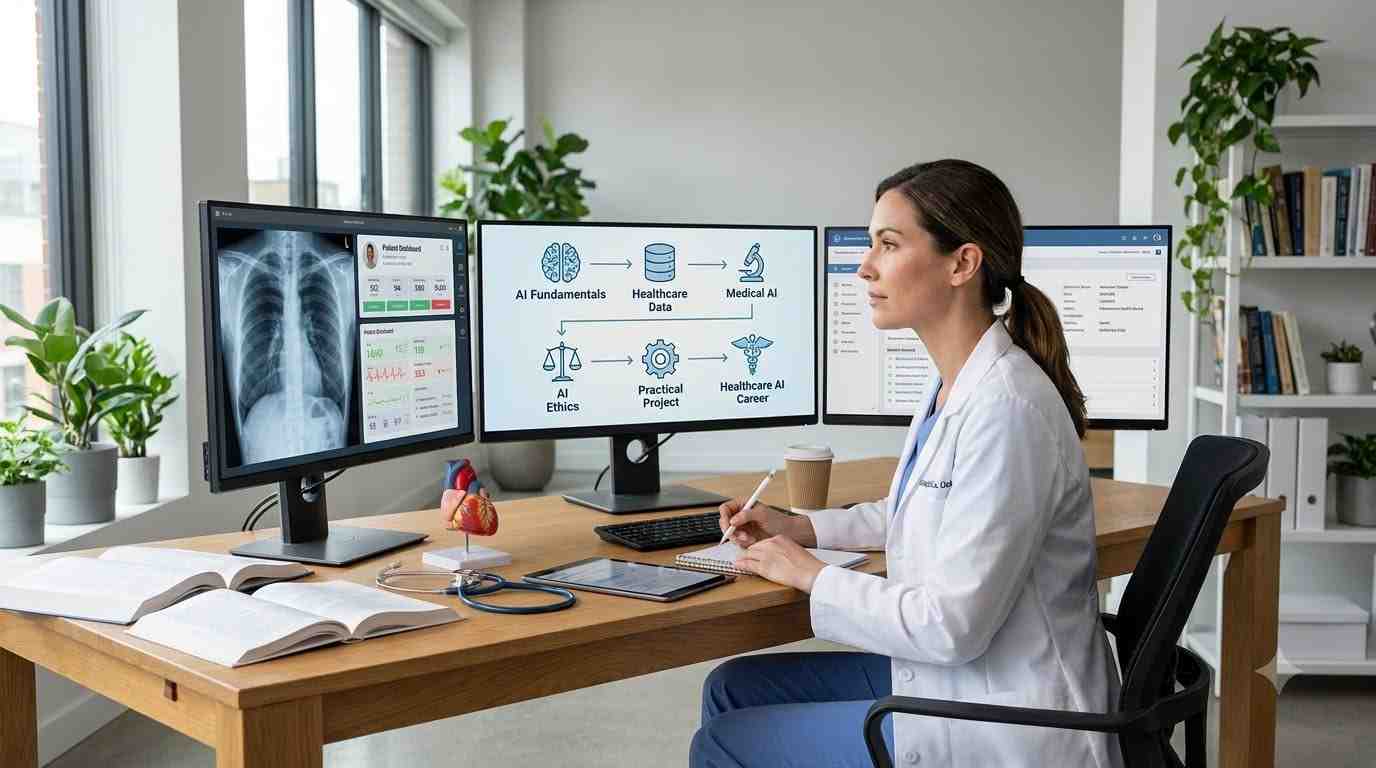
Instead of simply writing:
AI in Healthcare
be specific.
For example:
- Healthcare AI fundamentals
- Generative AI
- Healthcare data analysis
- AI ethics
- AI model evaluation
- Medical imaging AI
- Healthcare automation
- Prompt engineering
- Data privacy
- AI workflow design
If you completed practical projects, mention those too.
How to Choose the Right AI in Healthcare Course
Before enrolling, ask these 10 questions.
1. Who is the course for?
Beginner? Doctor? Manager? Developer?
2. Is coding required?
Don’t discover this after paying.
3. What exactly is in the syllabus?
Look beyond the marketing headline.
4. Does it include healthcare-specific examples?
Generic AI knowledge is not enough.
5. Are there practical projects?
Projects make learning more useful.
6. Who teaches it?
Check their professional and academic background.
7. Is the content current?
AI changes quickly.
8. Does it discuss ethics and privacy?
It should.
9. Does it explain AI limitations?
A trustworthy course should not sell unrealistic promises.
10. What will you actually be able to do after finishing?
This is probably the most important question.
Common Mistakes When Choosing an AI Healthcare Course
Choosing Based Only on the Certificate
A certificate does not automatically create expertise.
Choosing the Most Advanced Course
More technical does not always mean better.
Ignoring Healthcare Context
Generic AI knowledge may not prepare you for healthcare-specific problems.
Skipping Ethics
Healthcare AI involves sensitive data and real-world consequences.
Learning Only Theory
Without practical projects, knowledge can remain superficial.
Expecting a Job Immediately
One course rarely qualifies someone for an advanced AI role.
Skills, experience and projects matter.
A Simple 90-Day Learning Plan
If you’re a beginner, you can structure your learning like this.
Days 1–30: Understand AI
Learn:
- AI basics
- Machine learning basics
- Generative AI
- Healthcare AI applications
Read our AI in Healthcare guide alongside your course.
Days 31–60: Go Deeper
Study:
- Medical AI
- AI in Medicine
- Medical imaging
- Healthcare data
- AI ethics
- Privacy
Our guides on AI in Medicine and Medical AI can help you build this background.
Days 61–90: Build Something
Create one practical project.
For example:
Healthcare data → AI analysis → Dashboard → Human review
Or:
Patient request → AI classification → Workflow automation → Staff review
At this stage, you can also explore our guide to AI in Medical Field for additional application ideas.
Is an AI in Healthcare Course Worth It?
For the right learner, yes.
But don’t buy a course simply because “AI healthcare” sounds like a high-growth field.
Buy it because it teaches you a skill you can actually use.
If you’re a healthcare professional, the best course may teach you how to understand and evaluate AI.
If you’re a manager, you may need implementation and governance.
If you’re a developer, you may need machine learning and healthcare data engineering.
If you’re a student, you may want a combination of AI fundamentals, medical applications and practical projects.
There is no universal best course for everyone.
Frequently Asked Questions
What is an AI in Healthcare Course?
An AI in Healthcare Course teaches how artificial intelligence is used in healthcare, medicine, medical research, patient care, data analysis and healthcare operations.
Is an AI in Healthcare Course good for beginners?
Yes. Many introductory programs are designed for beginners and do not require previous AI experience. However, technical AI development courses may require programming and mathematics.
Do I need coding to learn AI in healthcare?
No. Coding is not necessary for AI literacy or many healthcare-application courses. Coding becomes important if you want to build machine-learning or AI systems yourself.
Can doctors learn AI without becoming programmers?
Yes. Doctors can learn AI concepts, clinical applications, limitations, ethics and evaluation without becoming AI developers.
What should I learn before an AI healthcare course?
Basic computer skills and an interest in healthcare are generally enough for beginner programs. Technical programs may require statistics, programming or data-science knowledge.
Can an AI healthcare course get me a job?
A course can help build relevant skills, but it does not guarantee employment. Projects, experience, education and technical ability may also be required.
What is the best AI in Healthcare Course?
There is no single best course for everyone. The right choice depends on your background, career goal, technical level, budget and the type of healthcare AI work you want to do.
Are free AI healthcare courses useful?
Yes. Free courses can be excellent for learning fundamentals before spending money on advanced training.
How long does it take to learn AI in healthcare?
Basic AI literacy can be developed relatively quickly, but becoming technically proficient in healthcare AI can require months or longer depending on your starting point and goals.
Is AI in healthcare a good career?
AI-related healthcare skills can be valuable as healthcare organizations adopt more digital tools. However, career opportunities depend on the specific role, technical skills, experience and local job market.
Conclusion
An AI in Healthcare Course can be a smart way to understand one of the fastest-changing areas of healthcare technology—but only if you choose the course for the right reason.
Don’t choose a course because it promises to make you an “AI expert” in a few weeks.
Instead, look for a program that teaches:
AI fundamentals + healthcare applications + practical skills + ethics + privacy + evaluation
And if you want to build a real career, don’t stop at the certificate.
Build projects.
Learn how healthcare data works.
Understand AI limitations.
Learn how to evaluate AI systems.
And most importantly, learn how to use AI responsibly.
Healthcare needs people who understand both sides of the equation:
Technology and patients.
That is where the real value of AI healthcare education lies.