

AI and Healthcare: 15 Powerful Ways AI Is Changing the Future of Health
For years, healthcare technology was mostly about digitizing paperwork, storing patient records and moving from physical files to computer systems.
Now something much bigger is happening.
Artificial intelligence is beginning to change how healthcare organizations analyze information, how doctors work with medical data, how patients interact with health services and how researchers discover new treatments.
This is where the relationship between AI and Healthcare becomes important.
AI can process huge amounts of information, identify patterns, summarize documents, assist with medical imaging and automate repetitive tasks. But healthcare is different from many other industries.
If an AI system makes a mistake in an online advertisement, the consequences may be small.
If an AI system provides incorrect information in a medical workflow, the consequences can be much more serious.
That is why the future of AI and Healthcare is not simply about using the most powerful AI model.
It is about using the right technology, for the right task, with the right human oversight.
For a broader introduction, see our complete guide to AI in Healthcare.
If you want to understand the medical side specifically, read AI in Medicine.
Table of Contents
- What Does AI and Healthcare Mean?
- Why Is AI Important in Healthcare?
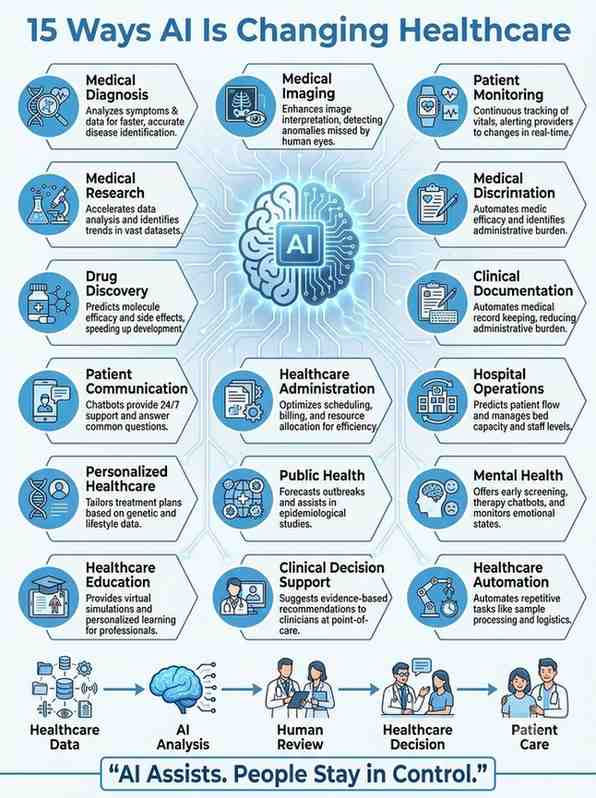
- 15 Ways AI Is Changing Healthcare
- Real-World Example
- Benefits of AI and Healthcare
- Problems and Risks
- AI and Doctors
- AI and Patients
- How Healthcare Organizations Can Start
- Future of AI and Healthcare
- Frequently Asked Questions
What Does AI and Healthcare Mean?
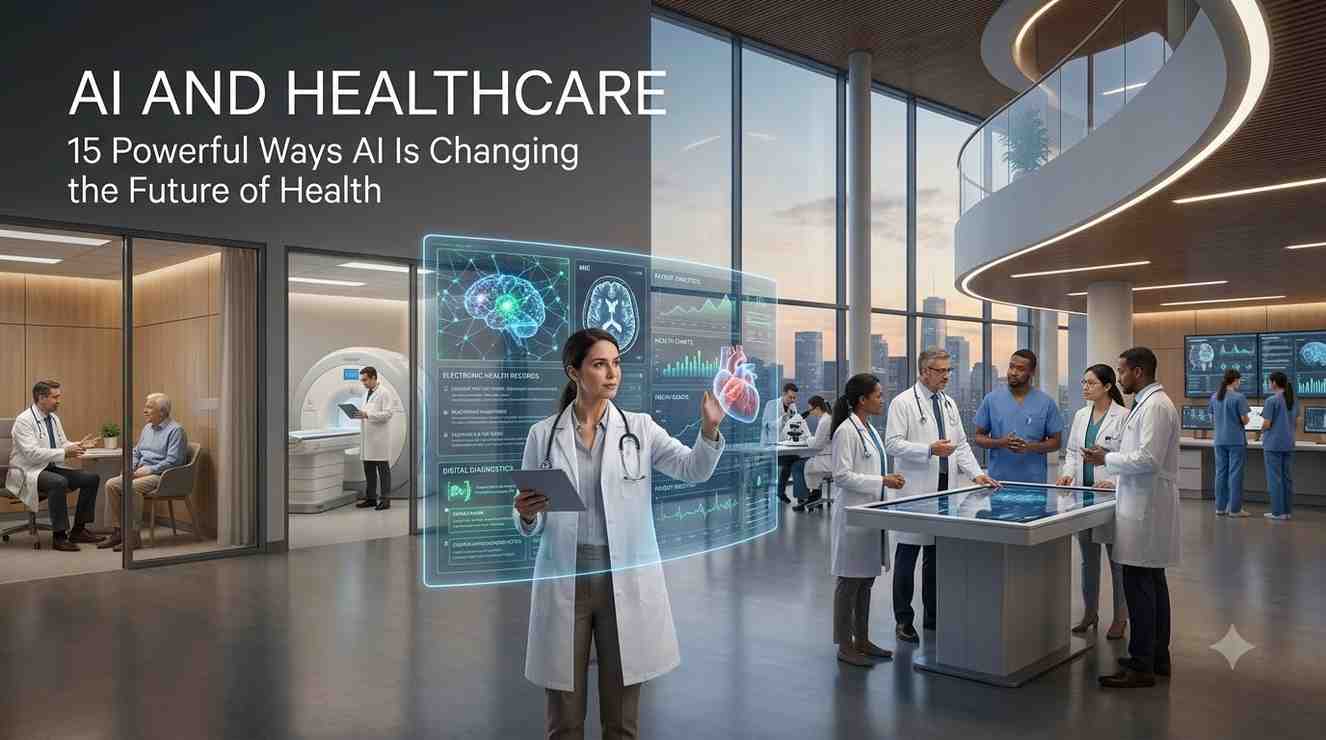
AI and Healthcare refers to the use of artificial intelligence technologies across healthcare services, medical practice, research, administration and health-system management.
It includes much more than diagnosis.
AI can be used for:
- Medical imaging
- Clinical decision support
- Patient communication
- Medical research
- Drug discovery
- Documentation
- Healthcare administration
- Hospital operations
- Patient monitoring
- Health data analysis
- Public health
This broader view is important.
Someone searching for AI and Healthcare may not be looking for a technical explanation of machine learning.
They may want to know:
“How is AI actually changing healthcare?”
That is what this guide focuses on.
Why Is AI Important in Healthcare?
Healthcare produces enormous amounts of information.
Consider everything that can happen during a patient’s journey:
Appointment → Medical history → Consultation → Tests → Images → Laboratory results → Diagnosis → Treatment → Follow-up
Each stage can generate data.
AI can potentially help organize and analyze parts of that information.
The World Health Organization’s 2026 implementation report on AI in health care focuses specifically on moving from theory to practical deployment and identifies lessons around implementation, governance and health-system readiness.
This is an important shift.
The question is no longer simply:
“Can AI do this?”
The better question is:
“Can AI do this safely and usefully in a real healthcare environment?”
15 Powerful Ways AI and Healthcare Are Coming Together
1. AI-Assisted Medical Diagnosis
One of the most discussed applications is diagnostic support.
AI systems can analyze specific types of medical data and identify patterns that may be relevant to a healthcare professional.
For example, specialized systems can assist with:
- Medical images
- Risk assessment
- Abnormality detection
- Disease classification
- Clinical decision support
But there is an important distinction.
AI assistance is not the same as autonomous diagnosis.
A doctor still needs to interpret the result within the patient’s overall clinical context.
For a deeper look at this topic, see our guide to Medical AI.
The FDA’s current AI-enabled medical device list includes authorized technologies across areas such as radiology, cardiovascular care and other specialties, showing that specific AI medical applications are already part of regulated healthcare technology.
2. AI in Medical Imaging
Medical imaging is one of the strongest examples of AI entering healthcare.
AI can be used with:
- X-rays
- CT scans
- MRI
- Ultrasound
- Mammography
- Digital pathology
A typical workflow might look like:
Medical Image → AI Analysis → Potential Finding → Professional Review
The AI may help identify or highlight something that deserves attention.
The healthcare professional then reviews the original information and makes the appropriate assessment.
This is one of the clearest examples of AI augmenting human expertise rather than simply replacing it.
3. AI for Patient Monitoring
Healthcare does not end when a patient leaves a hospital.
Wearable devices and connected medical technologies can generate health-related information over time.
AI can potentially analyze trends in:
- Heart rate
- Blood pressure
- Glucose
- Oxygen saturation
- Activity
- Other physiological measurements
The benefit is not necessarily that AI makes a diagnosis.
It may simply identify a change that deserves attention.
For chronic disease management, that kind of early signal can potentially become useful when integrated into an appropriate clinical workflow.
4. AI for Medical Research
Researchers have to deal with enormous amounts of scientific information.
AI can help with:
- Literature searches
- Data analysis
- Pattern recognition
- Research summaries
- Dataset organization
- Hypothesis generation
This can reduce some of the manual work involved in research.
But there is a catch.
AI-generated research summaries can contain errors.
Researchers therefore still need to check original studies, methods and evidence.
AI can accelerate research workflows.
It does not eliminate scientific verification.
5. AI and Drug Discovery
Developing a new medicine can take years.
Researchers have to evaluate enormous numbers of molecular possibilities and scientific relationships.
AI can help with tasks such as:
- Molecular analysis
- Compound screening
- Drug-target identification
- Predictive modeling
- Research prioritization
The goal is not to let AI “invent a medicine” and immediately give it to patients.
The goal is to use computational tools to make parts of the discovery process more efficient.
WHO identifies drug development as one area where AI has significant potential.
6. AI for Clinical Documentation
Ask a doctor what takes time during a busy day, and paperwork will probably be somewhere on the list.
AI can assist with:
- Transcription
- Note drafting
- Summaries
- Information organization
- Administrative documentation
Imagine this:
A doctor finishes a consultation.
Instead of starting documentation from a blank page, an AI system creates a draft.
The doctor reviews it.
The doctor corrects anything wrong.
The final record is then completed.
The AI has saved time without making the clinical decision.
That is a very practical example of where AI and Healthcare can work together.
7. AI for Patient Communication
Healthcare organizations answer thousands of routine questions.
Examples:
- What time is my appointment?
- What documents do I need?
- Where is the clinic?
- How can I reschedule?
- What are the hospital visiting hours?
AI assistants can potentially handle some of these routine requests.
But the situation changes when a patient asks:
“I have severe chest pain. What should I do?”
That is not the same type of problem as an appointment question.
Healthcare AI needs clear boundaries between administrative assistance and clinical decision-making.
WHO has highlighted concerns about AI producing convincing but incorrect health information and emphasizes safety, governance and human oversight.
8. AI for Healthcare Administration

Hospitals are large organizations with complicated administrative workflows.
AI can assist with:
- Scheduling
- Document processing
- Data extraction
- Reporting
- Coding support
- Workflow automation
- Resource planning
These applications may not sound as exciting as AI diagnosis.
But they can produce real business value.
If a healthcare organization saves hundreds of staff hours every month, that is measurable value.
9. AI for Hospital Operations
A hospital needs to manage:
- Beds
- Staff
- Equipment
- Appointments
- Operating rooms
- Patient flow
- Supplies
AI can potentially analyze historical information and help predict demand.
For example:
Historical demand → AI prediction → Management review → Resource planning
The final decision can remain with hospital management.
This is often a sensible way to introduce AI because the system is supporting an operational decision rather than making a high-stakes medical decision independently.
10. AI for Personalized Healthcare
Every patient is different.
Two people may have the same diagnosis but different:
- Medical histories
- Risk factors
- Treatment responses
- Lifestyle factors
- Other health conditions
AI can potentially analyze multiple data sources to support more personalized healthcare approaches.
However, personalization should not be confused with automatic treatment decisions.
AI can identify patterns.
Healthcare professionals still need to interpret what those patterns mean for an individual patient.
11. AI for Public Health
AI is also relevant beyond individual hospitals.
Health authorities can potentially use AI to analyze large datasets related to:
- Disease trends
- Population health
- Outbreak signals
- Healthcare demand
- Public health interventions
WHO’s 2026 work on AI and evidence-informed health policy highlights AI’s ability to support faster analysis, synthesis and use of large and diverse health data sources while emphasizing human judgment, governance and risk management.
This makes AI relevant not only to doctors and hospitals but also to public-health organizations.
12. AI in Mental Health
AI is increasingly being discussed in mental-health services, particularly around digital support and conversational systems.
But this is also an area where caution is extremely important.
A person experiencing a serious mental-health crisis is not the same as someone asking an AI chatbot for general information.
WHO experts have specifically raised concerns about generative AI systems being used for emotional support despite not being designed or tested for mental-health care.
This is a good example of why:
“AI can technically do something”
does not automatically mean:
“AI should be used for that purpose.”
13. AI for Healthcare Education
AI can also support learning.
Medical students and healthcare professionals can use AI for:
- Study assistance
- Case simulations
- Research support
- Explanation of complex concepts
- Practice questions
- Educational content
However, students should verify important medical information.
An AI-generated explanation can sound convincing while still containing an error.
For deeper learning, our guide to AI in Healthcare Course explains what skills and subjects beginners and professionals should look for in AI-healthcare education.
14. AI for Healthcare Decision Support
Healthcare professionals often have to combine information from multiple sources.
AI can help organize that information.
For example:
Patient records + laboratory results + medical history → AI summary → Professional review
This may reduce information overload.
But healthcare decisions should not become:
AI says X → therefore do X
A responsible workflow includes human verification.
WHO’s 2026 policy work explicitly describes AI as something that can augment rather than replace human judgment and recommends human oversight and multidisciplinary collaboration.
15. AI and Healthcare Automation
The most interesting applications may come from combining AI with automation.
For example:
Appointment Workflow
Patient request → AI classification → Scheduling system → Confirmation → Reminder
Documentation Workflow
Consultation → AI transcription → Draft note → Doctor review → Final record
Administrative Workflow
Incoming document → AI extraction → Structured data → Human verification → Healthcare system
This is where AI stops being just a chatbot and becomes part of a larger workflow.
A Real-World Example: What AI Should Actually Do
Imagine a hospital receives 1,000 imaging studies in a day.
A simplistic AI pitch might say:
“AI will diagnose all 1,000 patients.”
That sounds impressive.
But it is not necessarily the best way to design the system.
A more realistic workflow might be:
1,000 scans
↓
AI analyzes images
↓
Potential findings are highlighted
↓
Cases are prioritized
↓
Radiologist reviews the original images
↓
Final clinical assessment
The AI is doing something valuable.
But the professional remains involved.
That distinction is one of the most important principles in responsible healthcare AI.
Benefits of AI and Healthcare
When implemented appropriately, AI can provide several potential benefits.
Faster Information Processing
AI can analyze large datasets quickly.
Reduced Administrative Work
Automation can reduce repetitive tasks.
Better Workflow Efficiency
AI can help healthcare organizations organize complex processes.
Research Support
Researchers can analyze large datasets and scientific information more efficiently.
Diagnostic Assistance
Specialized systems can support specific diagnostic workflows.
Better Access to Information
AI can summarize and organize large amounts of information.
Potentially More Personalized Services
AI can help identify patterns across multiple sources of information.
WHO describes AI as having potential across diagnosis, clinical care, research, drug development, surveillance and health-system management, while stressing that safe deployment requires governance and appropriate capacity.
The Risks of AI and Healthcare
The benefits are real.
So are the risks.
Incorrect Outputs
AI can produce wrong information.
Bias
AI systems can reflect problems in their underlying data.
Privacy
Healthcare information is highly sensitive.
Security
AI systems can introduce additional cybersecurity considerations.
Lack of Transparency
Some systems are difficult to understand or explain.
Overreliance
People may trust AI simply because it sounds confident.
Changing Performance
A system that works well in one environment may behave differently in another.
The FDA’s AI program focuses specifically on evaluating safety and effectiveness of AI/ML-based medical devices and their intended uses.
AI and Healthcare: The Trust Problem
Trust is probably the biggest issue.
Imagine a doctor receives an AI recommendation.
Which statement would inspire more confidence?
Option A
“AI says this is the diagnosis.”
Option B
“The AI identified this finding as potentially important. Here is the relevant evidence, and the clinician can review the original data.”
Option B is much closer to how responsible healthcare AI should work.
Trust should come from:
- Evidence
- Validation
- Transparency
- Human oversight
- Data security
- Monitoring
Not from the words:
“Powered by AI.”
WHO’s 2026 implementation work emphasizes that health systems need more than technology; they also need governance, workforce readiness, data infrastructure and institutional capacity.
AI and Doctors: Will AI Replace Healthcare Professionals?
The short answer is:
Not in the simple way people often imagine.
Doctors do much more than process information.
They:
- Talk to patients
- Understand context
- Perform examinations
- Interpret uncertainty
- Discuss treatment options
- Consider patient preferences
- Take responsibility for decisions
AI can assist with some parts of this work.
But medicine is not simply a data-processing problem.
This is why our AI in Medical Field guide focuses on practical applications rather than the idea that AI will simply replace healthcare professionals.
AI and Patients: What Should People Know?
Patients will increasingly encounter AI in healthcare.
It may appear in:
- Appointment systems
- Chatbots
- Medical devices
- Imaging workflows
- Patient portals
- Remote monitoring
The important thing is to understand what the AI is actually doing.
If an AI system helps schedule an appointment, the risk is relatively different from an AI system supporting a diagnostic decision.
Patients should be comfortable asking:
“What is the AI being used for?”
“Who reviews the result?”
“How is my data protected?”
Those are reasonable questions.
How Should a Healthcare Organization Start Using AI?
Don’t start by asking:
“Which AI tool should we buy?”
Start with:
“Which problem are we trying to solve?”
Step 1: Identify the Problem
Find a repetitive, expensive or time-consuming process.
Step 2: Define the Outcome
For example:
- Reduce documentation time
- Improve scheduling
- Reduce administrative workload
- Improve information retrieval
Step 3: Evaluate the Technology
Check evidence, intended use and limitations.
Step 4: Run a Small Pilot
Don’t immediately deploy AI everywhere.
Step 5: Keep Human Oversight
Define exactly when a professional reviews the output.
Step 6: Measure Results
Track:
- Accuracy
- Time saved
- Cost
- Error rate
- Staff workload
- Patient experience
Step 7: Scale Only When It Works
If the pilot produces measurable value, expand it.
WHO’s 2026 implementation report specifically focuses on practical lessons for moving AI from theory into real health-system use.
AI and Healthcare in India
AI adoption is not limited to the United States or Europe.
India is also developing a national framework around responsible AI in health.
In February 2026, WHO highlighted India’s Strategy for AI in Healthcare (SAHI), describing it as a framework intended to support responsible, safe and scalable AI use in public health. The strategy focuses on areas including diagnostics, surveillance, research and more efficient service delivery.
This is particularly important because healthcare AI in India has to work across very different environments—from advanced urban hospitals to settings with limited infrastructure and specialist availability.
The technology therefore needs to be designed around actual healthcare conditions, not just laboratory demonstrations.
What Is the Future of AI and Healthcare?
The next stage of healthcare AI will probably be less about isolated AI tools and more about connected workflows.
Imagine:
Patient
↓
Digital Health System
↓
AI Analysis
↓
Doctor / Healthcare Professional
↓
Treatment / Service
↓
Monitoring
↓
Follow-up
AI could become a layer inside healthcare infrastructure rather than a separate product that people open occasionally.
At the same time, governance will become more important.
WHO reported in July 2026 that nearly two-thirds of countries in its European Region were already deploying AI in diagnostics, while only 8% had a health-specific AI strategy.
That illustrates an important reality:
Technology adoption can move faster than governance.
The future challenge is therefore not just building better AI.
It is building healthcare systems that know when, where and how AI should be used.
Frequently Asked Questions
What does AI and Healthcare mean?
AI and Healthcare refers to the use of artificial intelligence across healthcare services, medicine, research, administration, patient care and health-system management.
How is AI used in healthcare?
AI is used or being developed for medical imaging, diagnosis support, research, drug discovery, patient monitoring, documentation, administration, public health and healthcare automation.
Is AI in healthcare safe?
Safety depends on the specific system, its intended use, validation, implementation and monitoring. AI should not be considered safe simply because it uses advanced technology.
Can AI replace doctors?
AI can assist healthcare professionals with specific tasks, but it does not replace clinical judgment, communication, physical examination and professional accountability.
How can hospitals use AI?
Hospitals can start with clearly defined problems such as documentation, scheduling, information management, imaging support or administrative automation and then measure the results.
What are the biggest benefits of AI and Healthcare?
Potential benefits include faster information processing, reduced administrative work, research support, workflow improvements and assistance with specific clinical tasks.
What are the biggest risks?
Important risks include incorrect outputs, bias, privacy problems, cybersecurity concerns, lack of transparency, overreliance and changing performance.
Is AI in healthcare the future?
AI is likely to become increasingly integrated into healthcare systems, but its long-term value will depend on evidence, governance, workforce readiness, data quality and responsible implementation.
Conclusion
The relationship between AI and Healthcare is becoming much more practical.
We are moving beyond the question:
“Can AI be used in healthcare?”
The more important question is now:
“Where can AI create real value without compromising safety, privacy or human judgment?”
AI can help analyze medical images, support research, automate documentation, improve hospital operations, assist patients and process enormous amounts of health data.
But healthcare cannot afford to treat AI as a magic solution.
The strongest model is:
AI analyzes → Humans verify → Professionals decide → Systems are monitored
That approach combines the speed of artificial intelligence with the judgment and responsibility of healthcare professionals.
The future of healthcare is therefore unlikely to be simply AI replacing people.
It is much more likely to be people using AI responsibly to provide better, faster and more efficient healthcare.